AI知识库 | AI Knowledge Base

AI驱动的技术与知识分享

📎 附件资料

🖥️ 幻灯片预览(支持全屏)


1. The Context Window Bottleneck: Reimagining Memory for Long-Horizon Reasoning

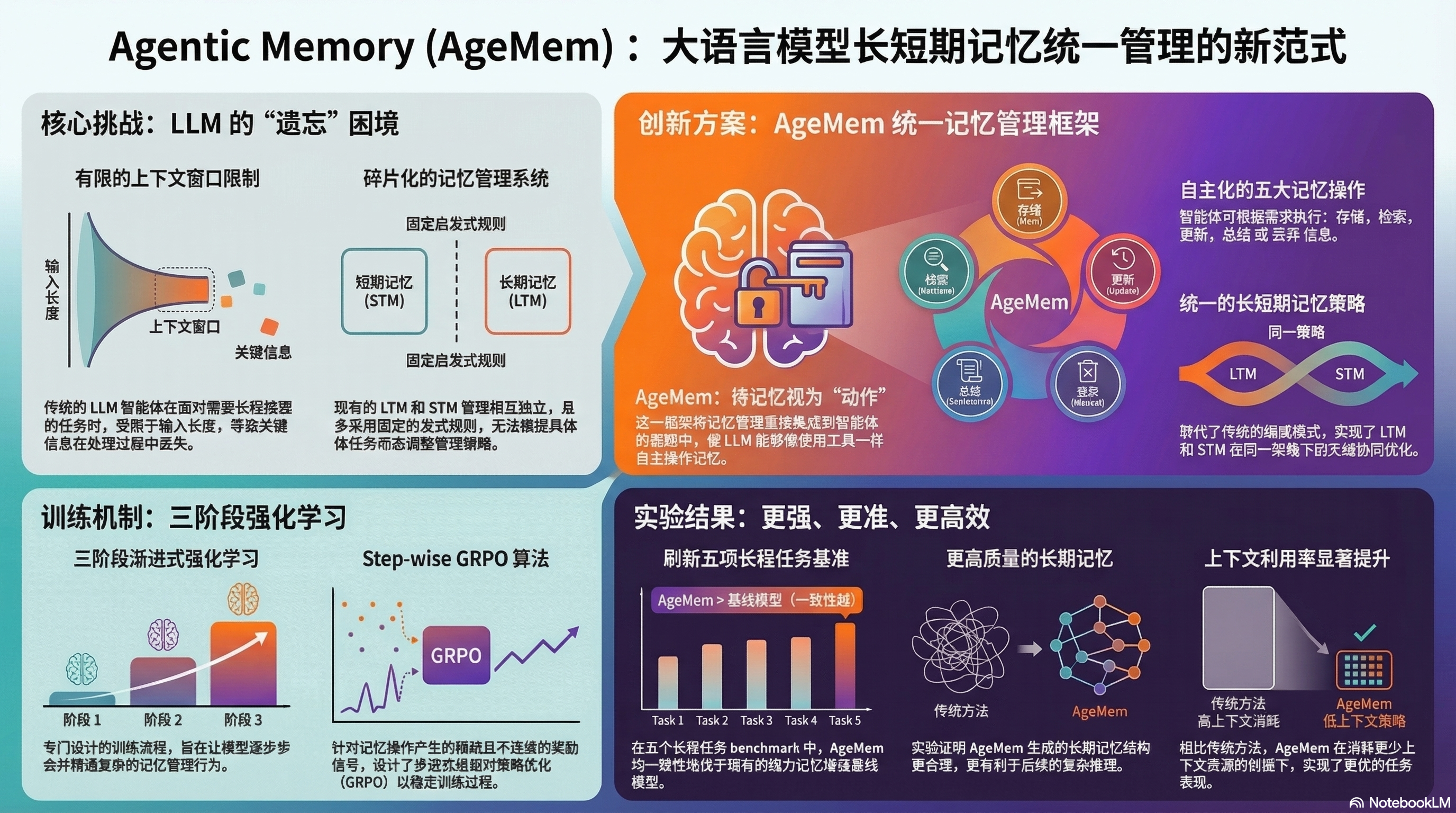
The current landscape of Large Language Models (LLMs) is defined by a persistent architectural constraint: the finite context window. While state-of-the-art models demonstrate remarkable proficiency in short-term information processing, their capacity for long-horizon reasoning—tasks necessitating the maintenance of state over extended temporal scales or complex sub-steps—remains fundamentally tethered to the volume of data that can be actively held in “working memory.” Overcoming these constraints is a strategic imperative for the development of autonomous agents; without sophisticated memory management, agents suffer from rapid performance degradation as critical task context is evicted or diluted.

The research presented by Yu et al. (2026) in “Agentic Memory: Learning Unified Long-Term and Short-Term Memory Management for Large Language Model Agents” addresses a core deficiency in existing systems: the reliance on passive heuristics or external auxiliary controllers. These modular approaches often fail to mitigate state-space fragmentation because they are decoupled from the agent’s primary reasoning policy. Such systems cannot be optimized end-to-end, leading to a “semantic disconnect” where the retrieval mechanism is unaware of the agent’s immediate reasoning requirements. The Agentic Memory (AgeMem) framework resolves this by treating memory management as a first-class citizen within the agent’s decision-making architecture.

2. Architectural Paradigm Shift: From Heuristics to Unified Agentic Policy

AgeMem marks a transition from modular, rule-based memory augmentation to a unified, policy-driven architecture. In this paradigm, Long-Term Memory (LTM) and Short-Term Memory (STM) are not managed by fixed algorithms (like RAG or sliding windows) but are integrated directly into the agent’s action space. This allows the model to harmonize policy gradients across both reasoning and memory-management tokens, ensuring that every internal state transition serves the final objective.

Feature Traditional Memory Augmentation AgeMem Unified Framework Latency/Overhead
Optimization Method Modular/Heuristic-based End-to-end Policy Optimization Higher (Inference-time logic)
Control Logic Fixed rules or auxiliary controllers Autonomous, policy-led decision making Moderate (Action sampling)
Adaptability Rigid; relies on predefined triggers High; model-agnostic and state-dependent Low (Native LLM policy)
Integration LTM and STM are separate silos Unified management within the action space Minimal (Integrated embedding)

The critical “So What?” of this architecture lies in its ability to enable end-to-end optimization. By embedding memory management into the agent’s policy, AgeMem allows the LLM to learn the latent utility of its own knowledge base. This eliminates the friction between “reasoning” and “remembering,” as the model can now weigh the cost of memory operations against the probability of task success. This integration facilitates a level of dynamic context steering that was previously impossible under rigid, heuristic-driven regimes.

By conceptualizing memory as an active toolset, the architecture transforms the agent from a passive consumer of context into an active curator of its own cognitive state.

3. Memory as a Toolset: The Taxonomy of Agentic Operations

The AgeMem framework innovates by exposing memory management as a discrete set of tool-based actions. This expansion of the action space allows the agent to exercise granular control over its internal knowledge state. The taxonomy consists of five core operations:

  • Store: The agent proactively identifies high-utility information within the current active context and commits it to LTM, ensuring that critical data is not lost when the context window shifts.
  • Retrieve: When the current STM is insufficient for the task at hand, the agent triggers a retrieval action to ingest specific, relevant historical data from the LTM back into the active window.
  • Update: To mitigate the risk of stale information, the agent can modify existing LTM entries. This ensures state accuracy over time, allowing the agent to correct previous assumptions as new data emerges.
  • Summarize: This operation manages state density by compressing high-cardinality information into concise representations, preserving the “semantic essence” while optimizing the token economy.
  • Discard: Essential for improving the Signal-to-Noise Ratio (SNR), the agent performs autonomous pruning of irrelevant or redundant data to prevent the cognitive clutter that often degrades long-context performance.

These operations allow the agent to govern its internal knowledge state with high precision. By distinguishing between “Update” (maintaining accuracy) and “Summarize” (managing context density), the agent optimizes its context window for maximum reasoning utility. This autonomous governance ensures that the most pertinent information is always prioritized, effectively extending the functional context window beyond its physical limitations.

Mastering this expanded action space, however, requires a specialized training methodology to overcome the challenges of non-differentiable memory operations.

4. Advanced Training Methodology: Progressive RL and Step-wise GRPO

Training an agent to master discrete memory operations is non-trivial due to the presence of sparse and discontinuous rewards. A “Store” action taken at an early timestep may not yield a discernible reward until much later in the episode, creating a significant credit assignment problem.

To resolve this, Yu et al. (2026) propose a Three-Stage Progressive Reinforcement Learning (RL) Strategy:

  1. Stage 1: Foundational Skill Acquisition: The agent is trained on supervised memory trajectories (behavioral cloning) to learn the basic mechanics and syntax of the five memory tools.
  2. Stage 2: Contextual Integration: The agent practices these operations within simplified reasoning environments, learning to trigger specific tools based on the current state-space.
  3. Stage 3: Unified Policy Refinement: The model undergoes full RL to optimize the interplay between memory operations and final task performance, harmonizing the policy for complex environments.

A pivotal innovation in this stage is Step-wise Group Robust Policy Optimization (GRPO). While standard GRPO (popularized for its efficiency in models like DeepSeek-R1) provides stability without a critic model, the “Step-wise” modification is critical for memory-heavy tasks. It enables intra-episode reward credit assignment, allowing the model to receive granular feedback on memory actions rather than relying solely on a single terminal reward. This prevents policy collapse and ensures that the model learns the delayed utility of specific “Store” or “Retrieve” actions, resulting in a more robust and stable gradient during the optimization process.

The successful implementation of this training regimen leads to a model capable of superior performance across diverse architectural backbones.

5. Empirical Validation: Performance, Quality, and Efficiency Gains

The AgeMem framework was evaluated across five rigorous long-horizon benchmarks. The results demonstrate that giving an agent autonomous control over its memory provides three primary value drivers:

  • Task Performance: AgeMem consistently outperformed strong baselines, including traditional RAG and fixed-rule memory systems. On long-horizon reasoning tasks, the model showed a significant delta in performance metrics like Pass@k, proving that agentic control over context is superior to static retrieval.
  • Memory Quality: Agentic control yields higher-quality long-term retention. By selectively “Storing” and “Updating” information based on task relevance, the LTM maintained a high SNR, avoiding the information dilution typical of automated heuristic storage.
  • Context Efficiency: The framework optimized the limited context window through autonomous pruning and summarization. This improved the token economy, allowing the model to maintain higher ROUGE scores for relevant context while using fewer total tokens.

The empirical data across multiple LLM backbones confirms that AgeMem is model-agnostic, providing a scalable solution for any agentic architecture requiring long-term state maintenance. These findings suggest that the framework’s ability to selectively manage its own knowledge base is a fundamental requirement for the next generation of autonomous AI.

6. Conclusion: The Strategic Implications of Autonomous Memory

The AgeMem framework, as detailed by Yu et al. (2026), redefines the role of memory in AI systems. By shifting from “memory as a static storage” to “memory as an agentic tool,” this research mitigates the fundamental constraints of finite context windows that have long hindered LLM development.

The strategic implication for systems architects is clear: the path to truly autonomous, persistent agents lies in the integration of memory management directly into the core reasoning policy. AgeMem provides the necessary blueprint for this evolution, demonstrating that when an agent is empowered to curate its own knowledge state, it achieves a level of reasoning depth and operational efficiency previously unattainable. This research sets a new standard for agentic architectures, paving the way for AI systems capable of handling the most complex, multi-step workflows in modern computing.
📎 附件资料

🖥️ 幻灯片预览(支持全屏)


1. Introduction: The Evolution of AI-Assisted Formal Proofs

The landscape of formal mathematical verification is shifting from simple “step-by-step manual entry” assisted by autocomplete tools (e.g., GitHub Copilot) to a paradigm of autonomous agent orchestration. In this new model, the mathematician transitions from a coder to a Principal Architect, overseeing high-throughput agents like Claude Code. This shift is necessitated by the inherent brittleness of “monolithic prompting.”

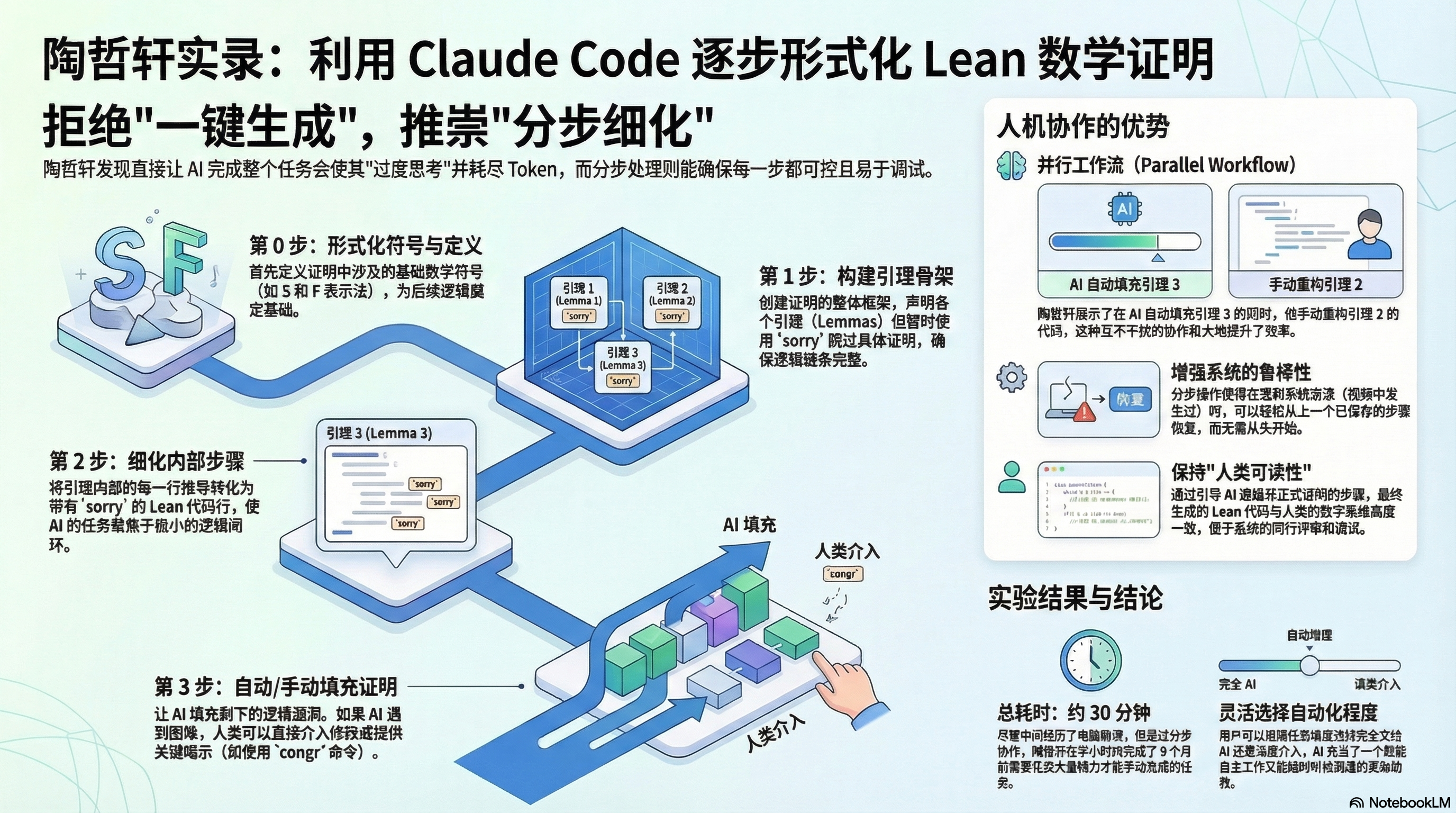
A naive approach—requesting a full formal proof in a single prompt—frequently collapses under the weight of its own complexity. As evidenced in high-level formalization tasks, such attempts often lead to system-level crashes, rapid context window pollution, and “stochastic wandering,” where the agent engages in sub-optimal branching within the proof search. Rather than converging on a solution, the agent “overthinks” the logic, burning tokens on unproductive tactical paths. To achieve professional-grade results, one must move away from unstructured requests toward a rigorous orchestration framework that constrains the agent’s state-space exploration.

2. The “Step-by-Step Recipe”: A Framework for Incremental Success

The primary defense against agent logic drift and task failure is the implementation of a granular “recipe.” By decomposing the high-level formalization goal into distinct, iterative phases, the architect maintains control over the agent’s logical trajectory and prevents the accumulation of “technical debt” in the proof state.

The following four-step framework provides a repeatable structure for formalizing complex informal proofs:

  1. Step 0: Notation & Definitions: Establish the symbolic foundation and notation “shortcuts” (e.g., S and F notations). This ensures the agent operates within a defined symbolic vocabulary, improving readability and reducing token overhead.
  2. Step 1: The Structural Skeleton: Formalize high-level lemma statements (e.g., Equation 1689) without attempting to prove them. Every lemma is closed immediately with the sorry tactic.
  3. Step 2: Line-by-Line Decomposition: Transform the informal proof’s prose into a sequence of Lean code lines. This creates a 1:1 parity between the human argument and the formal structure, with justifications still left as sorry.
  4. Step 3: Systematic Proof Filling: Replace the sorry markers with verified, compilable code, solving each sub-problem individually while monitoring for tactical efficiency.

This modularity ensures resumability. Long-running, unstructured tasks are vulnerable to system crashes and token exhaustion, which often result in total progress loss. However, a Lean file populated with sorry markers remains compilable; this allows the mathematician to restore the logical state immediately after a crash, picking up the formalization from the last verified lemma.

3. Strategic Skeletonization: Preventing LLM “Overthinking”

The “Skeleton-First” strategy is designed to decouple logical architecture (the “What”) from tactical implementation (the “How”). When agents are tasked with proving lemmas immediately, they often become bogged down in the “tactical weeds,” spending excessive context and time on low-level steps that they eventually fail or backtrack upon.

By establishing a “compilable but incomplete” skeleton, the architect fixes the global logical constraints. This prevents the agent from hallucinating divergent logical paths while struggling with local computation.

1
2
3
4
5
6
7
8
-- Example Skeleton State
lemma lemma_one (a b c : Theory) : SBA = a FPC :=
by
sorry

lemma lemma_two (x y z : Theory) : ... :=
by
sorry

This strategy ensures the formal output remains strictly aligned with the informal human proof. It forces the agent to follow the intended argument structure, resulting in a final product that is not only verified but also readable and debuggable for the human supervisor.

4. The Human-Agent Parallel Workflow

The “Parallel Workflow” represents a superior collaboration model where the human and agent operate on different logical tiers simultaneously. Rather than a sequential hand-off, the human performs high-level abstractions or manual tactical fixes while the agent concurrently handles the mechanization of the next phase.

A prime example of this is the extraction of a Key Equation Lemma (or “Slapped Ideal” lemma). While the agent is busy skeletonizing or filling routine “sorries” for a secondary lemma, the human architect may identify a repeating logical pattern and manually extract it into a standalone lemma. This simplifies the proof state and prevents the agent from struggling with redundant logic.

Level of Automation Decision Matrix

Task Type Assigned To Reasoning
Skeletonization Agent High-throughput structural task; establishes global state.
Routine Proof Filling Agent Mechanization of established logical steps.
Error Correction Human Required when agent enters a backtracking loop (stochastic wandering).
High-level Abstraction Human Identifying and extracting standalone lemmas (e.g., Slapped Ideal) to simplify the overall architecture.

5. Overcoming Technical Bottlenecks: Tokens, Logic, and Crashes

Current LLM agents are high-throughput but low-judgment engines. Navigating their limitations requires “constrained autonomy”—intervening at specific failure modes observed during long-range tasks.

  • Context Window Pollution: Unstructured tasks quickly deplete the context window with failed proof attempts.
    • Counter-Strategy: Use the step-by-step recipe to clear the context and focus the agent on a single, isolated sorry at a time.
  • Logic Drift & Over-expansion: Agents may expand terms too aggressively. A common error involves expanding a term like S_A twice when the proof requires only a single expansion to allow for cancellation.
    • Counter-Strategy: Manually intervene using the congr tactic or provide a “one-liner” hint to force the agent back onto a simplified, readable path.
  • Backtracking Fatigue: Agents burn significant tokens by repeatedly failing and retrying the same incorrect tactical branch.
    • Counter-Strategy: When an agent begins to loop, the human must provide a manual tactical intervention or extract a new lemma to reduce the complexity of the current goal.

6. Conclusion: The Future of Formalization via Agent Orchestration

The transition from “AI as a tool” to “AI as an agent” fundamentally redefines the mathematician’s role. Success is no longer measured simply by a finished proof, but by the mathematician’s ability to act as an architect who ensures the formalization is aligned with human reasoning and structured for long-term maintenance. Maintaining this alignment prevents the architect from “turning their brain off,” ensuring they retain the ability to debug and refactor the code as the project evolves.

Best Practices Checklist

  • [ ] Define Step 0: Establish all notation and symbolic shortcuts (e.g., S and F) before the first lemma.
  • [ ] Skeletonize First: Use sorry to map the global proof architecture before committing to local proofs.
  • [ ] Decouple Tiers: Tackle complex abstractions manually while delegating routine mechanization to the agent.
  • [ ] Monitor Expansion: Intervene immediately if the agent produces unreadable, “over-expanded” code blocks.
  • [ ] Ensure 1:1 Parity: Maintain strict alignment between informal proof lines and Lean code blocks to facilitate human-in-the-loop debugging.

📎 附件资料

🖥️ 幻灯片预览(支持全屏)


1. The Paradigm Shift: From Static Prompts to Encapsulated Skills

The current trajectory of Large Language Model (LLM) integration has reached a critical inflection point: the transition from “conversational companions” to an “autonomous workforce.” This strategic shift necessitates a move away from fragile prompt engineering toward a decoupled, “Skill-based” architecture. In this paradigm, intelligence is no longer a monolithic block of text but a library of encapsulated, dynamic capability units. This modularity allows for “Progressive Disclosure”—the architectural logic where complex capabilities are revealed and loaded only when relevant—minimizing context noise and maximizing execution precision.

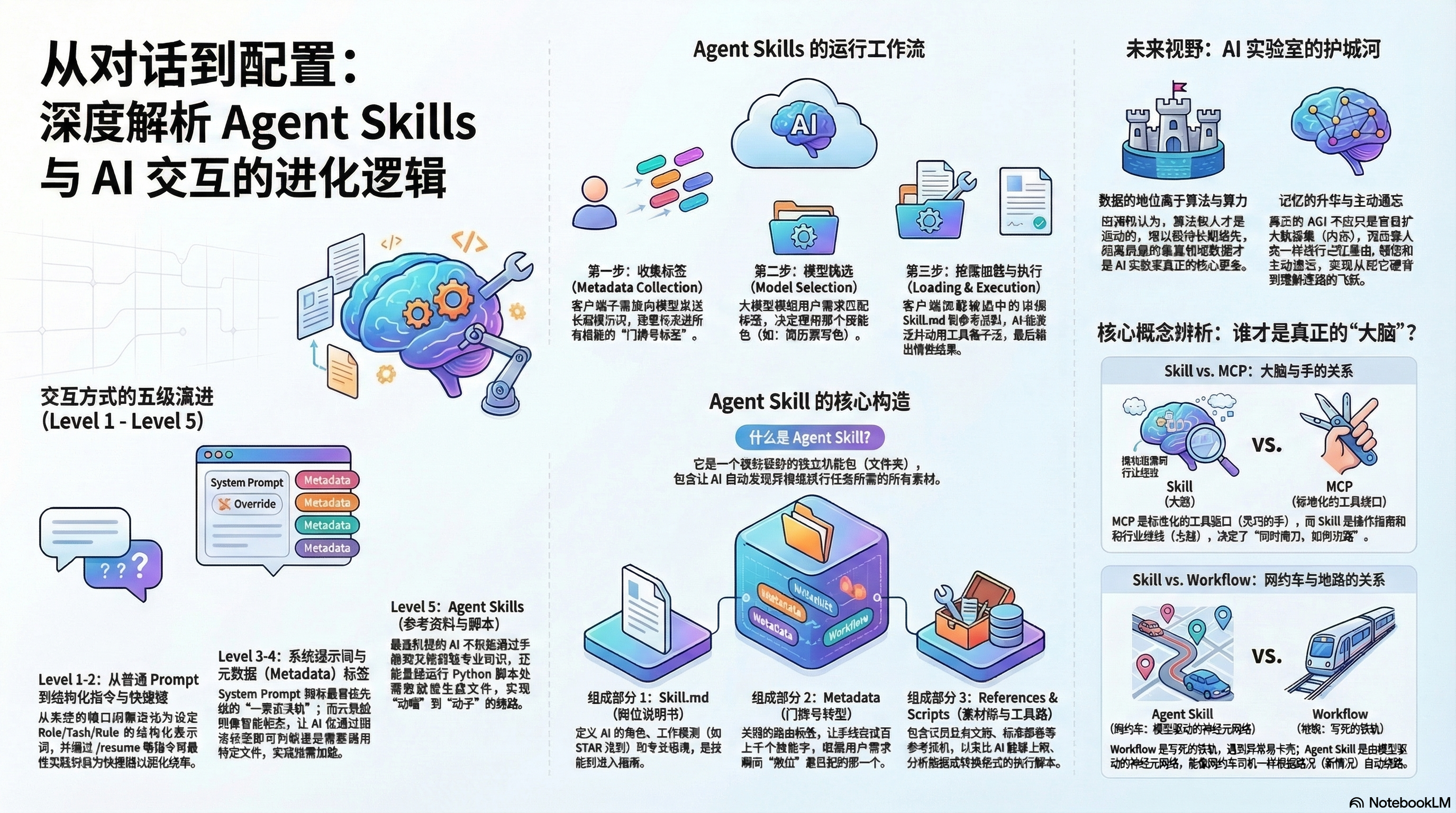
The evolution of AI interaction reflects a systematic drive toward higher state management and context isolation, categorized into five levels:

Evolutionary Taxonomy of AI Interaction (L1–L5)

Level Mechanism Technical Implementation Impact on Result Control
L1 Structured Prompt Role, Task, Constraints Transition from “Chatting” to Constraint-based Generation.
L2 Shortcut Command Trigger-based logic (e.g., /resume) Freezes best practices; encapsulates complex rules into single-token triggers.
L3 System Metadata system.md / cursorrules Establishes top-level priority; prevents Context Drift across long sessions.
L4 Routing Tags Metadata Tagging Enables “On-Demand Loading” (Lazy Loading) to resolve token overflow.
L5 Agent Skills Progressive Disclosure Full capability encapsulation; dynamic retrieval of instructions, data, and tools.

Modular Agent Skills allow for system-level maintenance without altering the core inference engine or monolithic application code. This architecture treats capabilities as “plugins” to the agent’s latent space, facilitating the transition from Level 1 to Level 5 autonomy.

2. The Four Pillars of Skill Composition

A standardized skill structure is mandatory for reliable model discovery and to mitigate “hallucinations of invention.” By providing a rigorous schema, we ground the agent’s behavior in specific domain experience rather than general-purpose probability.

2.1 Instructional Guidelines (skill.md)

This file defines the Experience (the “Brain”). It acts as the specific “Job Description,” utilizing frameworks like the STAR principle (Situation, Task, Action, Result). It dictates the cognitive logic, professional tone, and specific behavioral constraints the agent must adopt for a localized task.

2.2 Routing Metadata (Tags)

The “Door Plate” of the skill package. This lightweight metadata allows the system to perform discovery without loading the full instruction set into the context window. It facilitates efficient identification within the latent space, ensuring the agent only “activates” the skill when the user intent matches the tag.

2.3 Reference Materials (Data)

The “Reference Library” serves as a grounding mechanism. To prevent invention, the agent “consults and cites” internal business docs, templates, or manuals. This is the equivalent of “flipping through the manual” before answering, ensuring high-fidelity outputs aligned with organizational truth.

2.4 Execution Scripts (Tools)

The “Toolbox” represents the Interface (the “Hand”). These Python scripts or APIs facilitate the transition from Cognition to Action. Whether generating a formatted PDF, performing data analysis, or executing a search, these scripts move the agent from latent reasoning to deterministic system output.

[!NOTE] Architectural Composition Formula Skill = Domain Experience (skill.md) + Discovery Metadata (Tags) + Grounding Materials (Data) + Execution Interface (Scripts)

3. Operational Lifecycle: The 5-Step Discovery and Execution Flow

To achieve cost-efficiency and performance, the framework employs “Lazy Loading.” This ensures the context window is only populated with task-specific data, preserving the model’s limited attention resources.

The Standard Execution Workflow

  1. User Input Analysis: The client (e.g., claw or cbot) intercepts the raw request.
  2. Metadata Collection: The system aggregates only the door-plate tags from the skill library, ignoring the heavy instructional payloads.
  3. Model Selection: The LLM evaluates the lightweight tags to identify the specific skill package required for the task.
  4. Skill Activation: Once selected, the system pulls the full skill.md and reference materials into the active context window.
  5. Task Execution: The agent executes the relevant scripts/tools, grounding the output in the reference data to produce the final result.

Implementation Scopes

  • Personal Skills (**~/.cloud/skills**): Stored in the user’s home directory. These follow the developer across projects, encapsulating personal coding styles, commit message formats, and documentation preferences.
  • Project Skills (**.claw/skills**): Stored in the project root. These ensure team-wide standardization for brand guidelines, coding standards, and project-specific automation.

Note: While *claw.md* files (global instructions) are loaded into every conversation to maintain session-wide state, *skill.md* files are loaded strictly on-demand.

4. Comparative Analysis: Skills vs. Workflows vs. MCP

Navigating the “Agentic Era” requires a clear distinction between these three architectural patterns to avoid complexity debt.

Agent Skills vs. Traditional Workflows: “Ride-Hailing vs. Railway”

Traditional Workflows are like railways; they follow fixed, deterministic tracks (Step A -> Step B). They are inherently brittle and crash when encountering “unknown exceptions.” Agent Skills represent a “Ride-Hailing” model. The agent is goal-oriented; it knows the destination and uses its intelligence to dynamically re-route around obstacles or “traffic” (unforeseen errors), providing a resilient execution path.

Agent Skills vs. Model Context Protocol (MCP): “Brain vs. Hand”

MCP provides a standardized Interface (the “Hand”). It allows the model to connect to local files or databases. However, a hand without experience is useless. The Agent Skill provides the Domain Experience and judgment (the “Brain”), instructing the “hand” on when and how to use the tools effectively.

Architectural Logic Comparison

Category Logic Type Flexibility Ideal Use Case
Traditional Workflow Determinative / Linear Low Repetitive, predictable data pipelines.
MCP Interface-driven (Standardized) Moderate Standardized resource access (Databases/Files).
Agent Skill Intelligence-driven (Probabilistic) High Multi-step tasks requiring expert judgment.

5. Design Principles for Resilience and Memory

Building production-grade agents requires solving the “Context Window Exhaustion” and “Hallucination” problems through sophisticated memory management.

Technical Memory Hierarchy

  • Context/Short-Term Memory: Managed via Attention Sinks and the H2O (Heavy Hitter Oracle) mechanism. H2O ensures that even as the system selectively “forgets” less relevant tokens to save memory, it retains “heavy hitter” tokens essential for maintaining conversational coherence and factual accuracy.
  • Long-Term/Weight Memory: Established during pre-training/fine-tuning; provides the agent’s foundational world-view.
  • Human-Readable Memory: Following the Cbot architecture, memory must be organized into hierarchical Markdown files (Short-term/Long-term task logs). This allows for system transparency and manual pruning of “bad memories.”

Implementation Standards for Architects

  1. Rule of Context Isolation: Utilize metadata tags for discovery; never pre-load full instruction sets or skill.md files into the global context.
  2. Rule of Fail-over Cognition: If an Execution Script returns a stderr or null value, the agent must be programmed to invoke the skill.md logic to analyze the error and dynamically re-route via an alternative tool.
  3. Rule of Auditable State: All persistent updates to “long-term” agent memory must be written to human-readable Markdown logs, ensuring the agent’s “learning” is auditable and non-hallucinatory.

This framework transforms general-purpose LLMs into specialized experts, moving beyond simple text generation into the realm of intelligence-driven execution paths.

📎 附件资料

🖥️ 幻灯片预览(支持全屏)


1. Executive Summary and Strategic Context

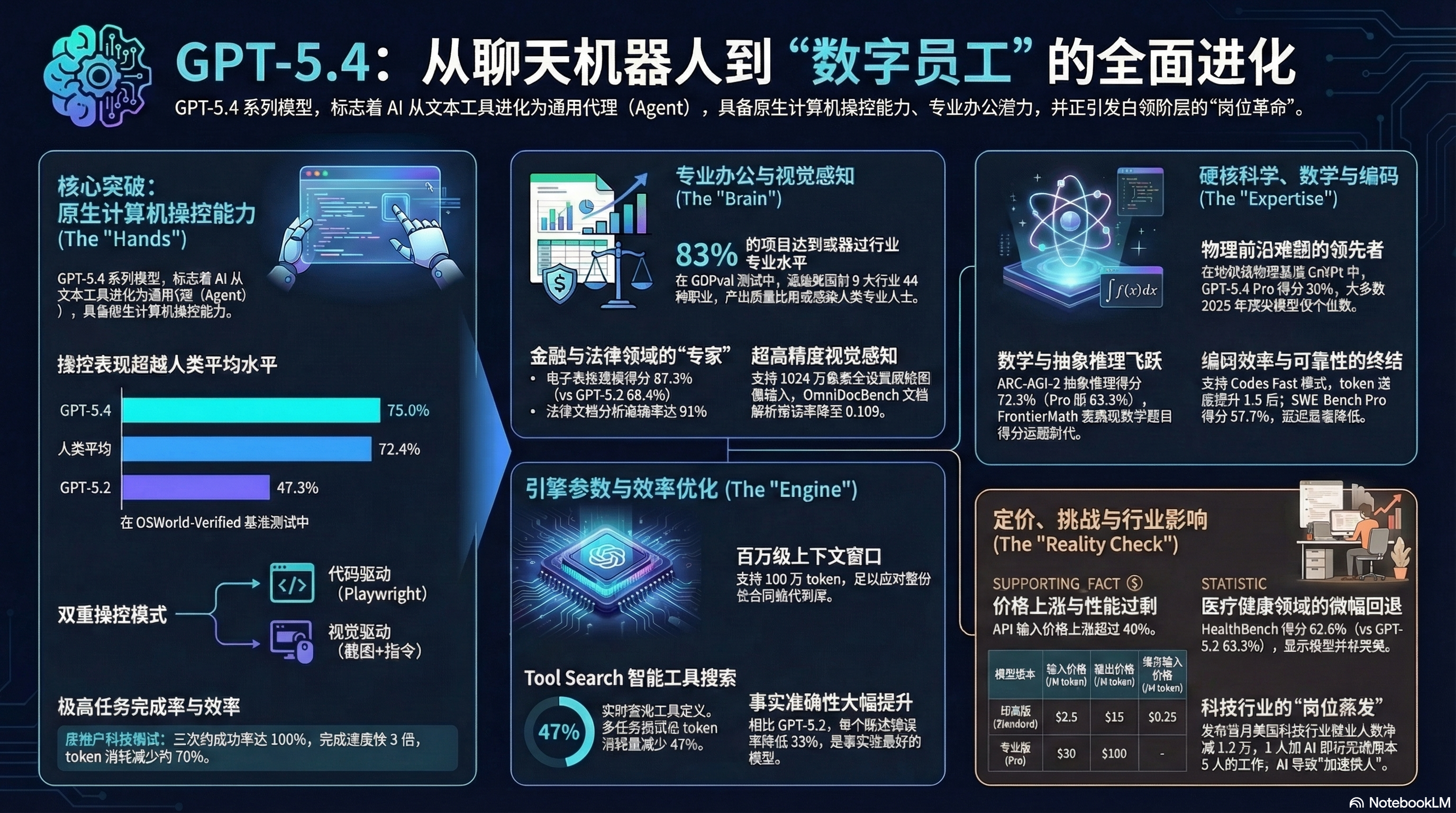
The release of GPT-5.4 (Thinking and Pro versions) marks the definitive transition from conversational AI to the era of “Digital Employees.” Architecturally, GPT-5.4 serves as the orchestration layer for the autonomous enterprise, integrating high-level reasoning, complex logic synthesis, and native computer control into a unified framework. For the strategic leader, this update represents a move away from “chatting with a bot” toward “deploying a workstation-ready agent” capable of executing end-to-end workflows within the existing corporate software stack.

Core Architecture and Capability Overview

Feature GPT-5.4 Thinking (Standard) GPT-5.4 Pro
Primary Capability Native Computer Use & Reasoning High-End Research & Logical Synthesis
Context Window 1,000,000 Tokens 1,000,000 Tokens
Strategic Function General Knowledge Work Automation Scientific/Technical Breakthrough Capacity
Availability Plus, Team, Pro, Enterprise Pro and Enterprise

These advancements collectively redefine enterprise productivity benchmarks. By transitioning from answering queries to occupying workstations, GPT-5.4 collapses the gap between strategic intent and operational execution.

-——————————————————————————-

2. Native Computer Use (NCU) and Visual Perception Mastery

Native Computer Use (NCU) is the foundational requirement for the autonomous digital workforce. Unlike traditional RPA (Robotic Process Automation) or API-dependent tools, GPT-5.4 interacts with the operating system as a human does: via visual perception and peripheral input. This represents a departure from rigid integrations toward flexible, human-centric automation.

Performance on OSWorld-Verified Benchmark

The model’s mastery of the OS environment is evidenced by its 75.0% success rate on the OSWorld-Verified benchmark, significantly outperforming GPT-5.2 (47.3%) and even exceeding human performance (72.4%).

The “So What?” Evaluation:

  • Human-Centric UI Automation: Exceeding human-level performance (75%) allows the model to reliably navigate legacy software and internal tools that lack dedicated APIs, rendering traditional integration barriers obsolete.
  • Obsolescence of API-limited Workflows: The agent can operate directly on the desktop, managing files and cross-application tasks via coordinates and screenshots, moving the bottleneck from “software compatibility” to “instruction clarity.”
  • High-Reliability Execution: The leap from 47.3% to 75.0% indicates that agentic workflows have moved from experimental “proofs of concept” to production-ready deployments.

Efficiency and Fidelity: The Mainstay Case Study

Analysis of data from Mainstay CEO Dodd Fraser confirms these gains in the real estate sector. In a test across 30,000 property tax portals, GPT-5.4 achieved a 95% first-try success rate and 100% within three attempts, compared to just 73-79% for previous models. These results were accompanied by a 3x increase in execution speed and a 70% reduction in token consumption.

To achieve this, GPT-5.4 utilizes the “Original Image Input Precision Mode,” supporting up to 10.24MP (6,000 pixels on the longest side). This high-fidelity perception is the model’s competitive advantage, allowing it to parse complex UI hierarchies and documents with a 0.109 error rate (OmniDocBench). Coupled with a 92.8% success rate in Online-MindToWeb (screenshot-only interaction) and 67.3% in WebArena-Verified, the model establishes itself as a viable, browser-based automation agent capable of complex document parsing and data entry without human intervention.

-——————————————————————————-

3. Vertical Industry Performance and “GDPval” Benchmarking

The economic utility of GPT-5.4 is quantified via the GDPval benchmark, which evaluates performance across 44 occupations in the top nine U.S. industries. This benchmark measures whether AI output reaches “Professional Parity” with human industry practitioners.

Industry Performance Matrix

Metric GPT-5.4 GPT-5.2
GDPval Overall Success 83.0% 70.9%
Investment Banking (Excel Modeling) 87.3% 68.4%
Legal Document Accuracy (Harvey BigLaw) 91.0% N/A
Professional Clear Win Rate 69.2% N/A

The Professional Parity Layer

The 69.2% clear win rate over industry professionals suggests that GPT-5.4 is no longer just assisting; it is outperforming. In the legal sector, the Harvey BigLaw Bench results (91% accuracy) highlight the model’s ability to maintain consistency across long-form contracts and analyze structured complex transactions with granular detail. In financial services, the automation of scenario analysis led to a 30-percentage-point increase in accuracy. This data indicates that the “white-collar revolution” is underway, as the model demonstrates the ability to handle the primary drafting, modeling, and analytical tasks of senior-level roles.

-——————————————————————————-

4. Advanced Coding, Engineering, and Scientific Reasoning

The evolution of the Codex engine has transformed coding from a pattern-matching task into a deep logical synthesis. The introduction of “Thinking” and “Fast” modes (offering a 1.5x token speed increase) significantly reduces developer friction and latency.

Benchmarks in Engineering and Science

  • SWE-Bench Pro: 57.7% (surpassing the 56.8% of GPT-5.3-Codex).
  • APEX-Agents: 50%+ (the first model to cross this threshold, up from <5% just one year ago).
  • FrontierMath: 38.0% (Pro version) on Tier 4 competition-level problems.
  • CritPt (Physics): 30.0% for Pro (xhigh).

The “So What?” of Scientific Reasoning: The CritPt benchmark consists of 71 unpublished, “hell-level” problems. Scoring 30.0% on data the model could not have encountered in training is definitive proof of reasoning over pattern matching. This capability allows the model to act as a genuine research collaborator, capable of high-level synthesis such as reverse-engineering Nintendo NES ROMs or building custom compilers from scratch—tasks where competitors often stall.

Infrastructure for Reasoning

Sustaining this level of intelligence requires a robust hardware and contextual backbone. The 1M-token infrastructure and the ability to toggle between “Thinking” and “Fast” modes allow the system to manage entire codebases or massive scientific datasets simultaneously, providing the necessary compute-depth to resolve problems that previously required human-level intuition.

-——————————————————————————-

5. Large-Scale Context Reliability and Tool Ecosystem Optimization

While 1M-token context windows offer vast potential, the MRCR v2 benchmark reveals a significant “Unreliability Zone” at the upper limits. Architects must design systems that respect these retrieval decay boundaries.

Context Retrieval Performance (MRCR v2)

Context Zone Token Range Retrieval Accuracy Strategic Classification
Practical Utility Zone 0 - 128K 86% - 97% Reliable Production Use
Marginal Utility Zone 128K - 256K 79.3% Requires Verification
High-Risk Zone 256K - 512K 57.5% Experimental Only
Unreliability Zone 512K - 1M 36.6% Non-Viable for Precision

Tool Ecosystem Efficiency

To solve “context bloating,” GPT-5.4 introduces Tool Search via the MCP Atlas benchmark. By utilizing a “lightweight list” approach—querying full tool definitions only when required—the model achieved a 47% reduction in token consumption. This allows for the integration of dozens of tools (e.g., 36 MCP servers) without sacrificing speed or accuracy. Additionally, the Thinking version’s real-time reasoning previews allow for user-directed course correction, further optimizing the consumption of compute resources.

-——————————————————————————-

6. Economic Analysis: Pricing, ROI, and Performance Regression

Deploying GPT-5.4 requires a nuanced “cost of intelligence” strategy. The Pro version offers unprecedented depth but at a premium that necessitates a strict Enterprise Routing Strategy.

API Pricing Structure

Model Version Input (per 1M) Output (per 1M)
GPT-5.4 Thinking $2.50 $15.00
GPT-5.4 Pro $30.00 $180.00

Cost-to-Value Critical Analysis

The Pro model’s propensity for “over-thinking” can lead to significant economic inefficiencies. The “Hello” problem—where a Pro model cost a CTO $80 for a five-minute reasoning chain on a simple greeting—highlights the need for dynamic routing. Enterprises should route 90% of tasks to the Thinking/Standard model, reserving Pro for specialized research, physics, or high-stakes coding.

Furthermore, minor regressions in HealthBench (62.6%) and Terminal-Bench 2.0 (75.1%) should be viewed as multi-modal optimization trade-offs. The architecture is being tuned for general-purpose computer use and reasoning, occasionally at the expense of hyper-specialized terminal command or medical consensus performance.

-——————————————————————————-

7. Governance, Safety, and the “White-Collar Revolution”

GPT-5.4’s autonomic capabilities are balanced by high-level safety ratings and a paradoxical impact on the labor market.

Safety and Security

  • Preparedness: Rated “High” for Cybersecurity and Biochemistry.
  • Integrity: Deception rates remain low at ~1%.
  • COT Controllability: The model demonstrates lower control over its internal reasoning chains; while this may seem like a drawback, it serves as a security feature that prevents external prompts from masking malicious logic or overriding internal safety protocols.

The Structural Unemployment Trend

The deployment of GPT-5.4 is actively restructuring the workforce. Data shows a net loss of 57,000 tech jobs over the last year (12,000 in the last month alone). This is not a symptom of corporate failure, but of AI efficiency:

  • Obviating Roles: Organizations are moving from 5-person teams to “1 Human + 1 AI.”
  • Cannibalizing General Talent: While general software and administrative roles are being displaced, vacancies for AI-specific developers are surging.

GPT-5.4 has moved from answering questions to occupying workstations. It is no longer an assistant; it is a digital employee that is quietly, but aggressively, infiltrating the global workforce.

📎 附件资料

🖥️ 幻灯片预览(支持全屏)


1. The Macro Perspective: 2026 as the Definitive Strategic Inflection Point

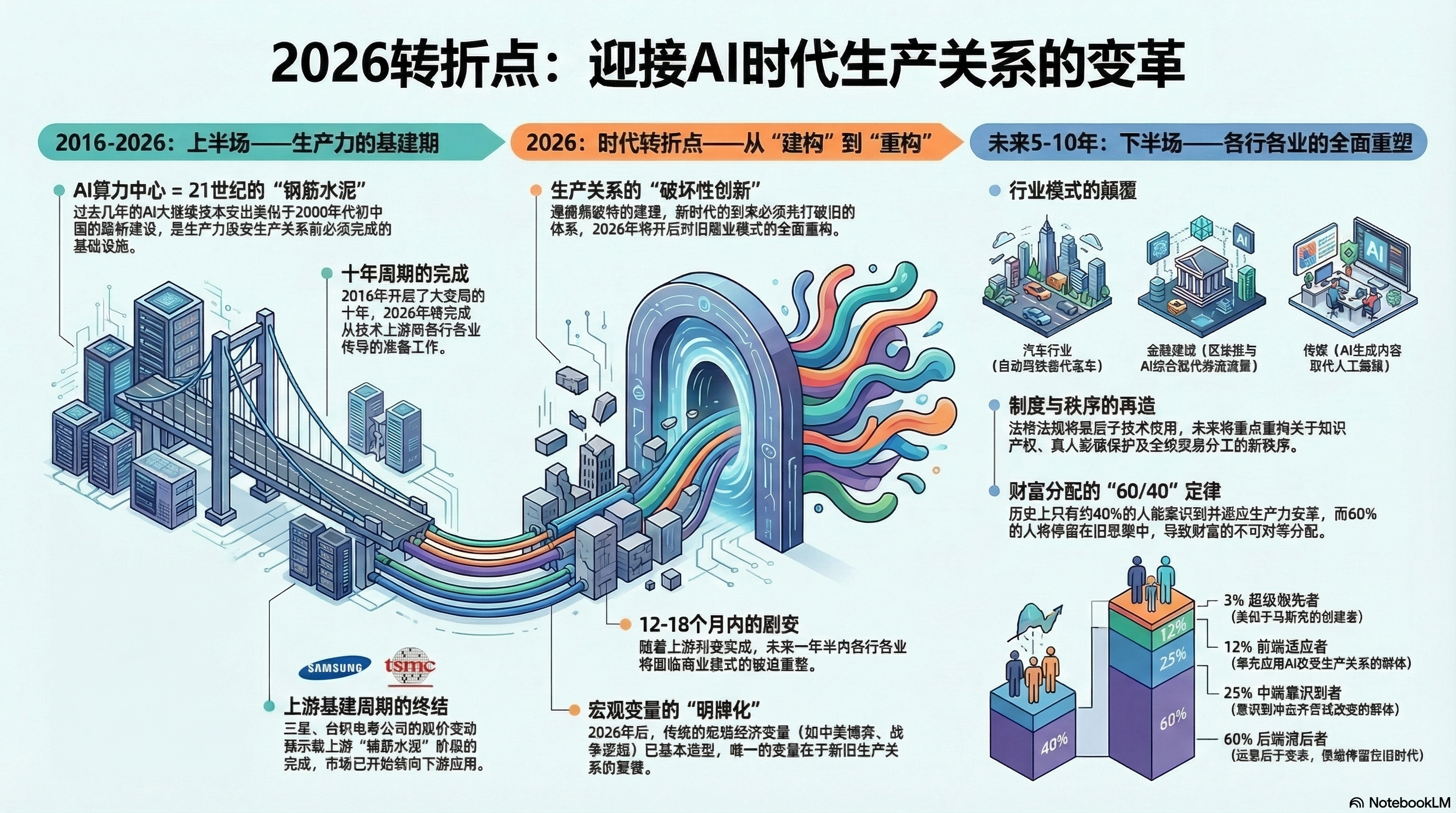
The decade spanning from 2016 to 2026 will be recorded as a “century-level” structural pivot. We are currently navigating the final transition of a ten-year cycle, shifting from an era of “Construction” (asset accumulation) to a period of “Competition” (model dominance). In the logic of macro-evolution, 2026 represents the critical handover point. If the first half of this cycle was defined by the accumulation of technological potential, the second half is defined by the violent restructuring of global production relations.

This transition is driven by the synchronization of the Three-Gear Framework:

  1. Production Forces (Productivity): The raw technological capacity, now exploding through AI and ubiquitous compute.
  2. Production Relations: The business models, labor structures, and organizational hierarchies that utilize those forces.
  3. Institutional Order: The legal, geopolitical, and financial systems that provide the rules of engagement.

When these gears align, the result is “Destructive Reconstruction.” We are witnessing a historical rhyme of the late 1960s to the early 1980s. During that era, the “Nationalism” of the Cold War prioritized strategic physical assets—metals like Silver and Tin (famously cornered by the Hunt brothers) for missile guidance and heavy industry. Today, the focus has shifted from “Nationalism” to a “Market Logic” defined by Total Factor Productivity, where the primary strategic asset is no longer a physical metal, but Intelligence.

Historical Parallel: The Great Transition

Dimension Industrial-to-Semiconductor (1960s-80s) AI-Driven Transition (2016-2026+)
Geopolitical Tension Cold War heights; focus on strategic metals (Silver/Tin) for nuclear deterrents. Tech Sovereignty; focus on Intelligence/Compute as the primary production factor.
Technology Adoption From manual typewriters and paper ledgers to Personal Computers (PC) and DOS/Windows. From manual search and App-based ecosystems to AI-synthesized intelligence and FSD.
Institutional Reform Thatcherism/Reaganism; dismantling legacy welfare states for market efficiency. Reconstruction of IP, financial direct-clearing, and algorithmic governance.

As we exit the “Building Phase” of this cycle, corporate strategy must pivot from asset-building to aggressive model-restructuring. In this high-stakes environment, holding onto legacy success is a form of structural arbitrage against one’s own future.

-——————————————————————————-

2. The “Steel and Cement” of the Digital Age: Completion of Upstream Infrastructure

In recent years, the massive capital expenditure (CapEx) in AI has been dismissed by some as a “debt trap.” This perspective fundamentally misinterprets the nature of industrial transmission logic. We are currently reliving the high-impact debate of the early 2000s between Lin Yifu and Guo Zhong regarding Chinese infrastructure: Is it “wasteful debt” or a “productivity prerequisite”?

Just as China built the roads before the cars in 2002, the current explosion in data centers and computing power is the “steel and cement” of the digital age. This infrastructure is not a burden; it is the foundational requirement for the “Upstream-to-Downstream” transmission cycle.

We are currently at the Peak of the Raw Material Cycle. The recent stock market performance of upstream giants like Samsung Electronics, SK Hynix, and TSMC mirrors the 2002–2005 Chinese stock cycle. Back then, the bidding for roads and bridges led to a peak in steel and cement prices, signaling that the infrastructure was largely complete. Today, when the “raw materials” of AI—semiconductors—reach their peak investment, it signals the immediate beginning of industry-wide destructive reconstruction for the downstream. The “roads” are now paved; the focus must shift entirely to the “vehicles” (business models) that will dominate them.

-——————————————————————————-

3. Creative Destruction: The 12-18 Month Efficiency Revolution

We have entered a 12-to-18-month window of Schumpeterian “Creative Destruction.” In the ledger of history, “death” of the old is the non-negotiable prerequisite for “birth” of the new. Efficiency is no longer an incremental KPI; it is a violent reordering of capacity enhancement and process shortening.

The “Efficiency Revolution” is dismantling legacy structures across three critical fronts:

  • Transportation/Automotive: We are transitioning from vehicle ownership to autonomous utility. The integration of Full Self-Driving (FSD) is transforming the car into a functional service. This renders the labor-heavy models of “ride-hailing drivers” and traditional taxi fleets structurally obsolete.
  • Media/Information: We are witnessing the “Disappearance of the App.” The paradigm is shifting from searching and clicking to “Direct AI Questioning.” As Sun Yuchen noted, the future isn’t about communicating with humans; it’s about asking AI to interpret human intent. When users ask an AI agent to “synthesize the last 24 hours of news,” the entire intermediary layer of editors and researchers collapses.
  • Professional Services: The foundational “hand-work” of coding, basic research, and editorial synthesis is facing an efficiency collapse. Programmer anxiety is not a trend; it is the first wave of a massive compression in the value of human intermediaries.

The Strategic Reality: There is no “harmonious coexistence” with AI while maintaining 20th-century processes. To achieve the 10x gains offered by new production forces, businesses must first dismantle the labor-intensive workflows of the past. If you do not destroy your current model, the market will perform the execution for you.

-——————————————————————————-

4. Institutional Lag and the Reordering of the Global Logic

Technological production forces move at light speed, while institutional frameworks move at the speed of bureaucracy. This friction creates a “chaotic zone” where the rules of the old world are increasingly irrelevant.

We identify three Institutional Reconstruction Zones:

  1. Intellectual Property & Identity: AI-generated content and deepfakes represent an existential crisis for IP. Legal frameworks must shift to protect personality rights and digital identities as real, tradeable assets, moving away from 20th-century copyright logic.
  2. Financial Infrastructure: We are moving toward “Wallet-to-Wallet Direct Trading.” The traditional chain of “Bank \rightarrow Broker \rightarrow Exchange” is full of institutional friction. Blockchain-integrated AI will allow direct clearing and settlement, removing the need for 20th-century intermediaries who exist only to facilitate trust.
  3. Global Trade & Geopolitics: The logic of production factors has shifted from physical territory and raw materials to intelligence and compute. Traditional “territory-grabbing” warfare is becoming strategically obsolete.

Geopolitical Insight: Current global conflicts (Eastern Europe, the Middle East) are not the “start” of a new era of war; they are the “violent end” of the old order. They represent the final gasps of a system based on old production factors. The new global order will be dictated by those who control the efficiency of the AI value chain, rendering physical territory a secondary concern.

-——————————————————————————-

5. Strategic Differentiation: Navigating the 15/85 Cognitive Divide

The reordering of production relations dictates a new, non-linear distribution of wealth. This is not a matter of social fairness, but of cognitive adaptability. Based on historical technology cycles, we face a specific Cognitive Distribution Rule:

  • 3% are super-leaders and creators driving the change.
  • 15% are early adopters at the front end (the “Survivors”).
  • 40% only grasp the impact once mass application is already complete.
  • 60% are the “Lagging Group,” whose roles and skills have become structurally obsolete.

To remain in the Top 15%, decision-makers must execute a three-step “Survival & Growth” checklist:

  1. Embrace “Pre-fabrication”: Abandon the “hand-made” nostalgia of the past. Much like the transition from “artisanal” sushi to high-efficiency pre-made production, the market no longer rewards the “human touch” at the cost of scale. If the future is moving toward pre-fabrication, you must integrate AI workflows or face the “hand-made” price trap.
  2. Shorten the Value Chain: Aggressively identify where AI can eliminate intermediate costs. Any process that involves mere “information relay” or “manual synthesis” is a structural liability.
  3. Join the Vanguard: If you cannot beat the efficiency curve, you must join it. Resistance is not a strategy; it is a path to the bottom 60%.

The Final Verdict: The coming 18 months will define the winners and losers of the next decade. Success is no longer found in defending what you have built, but in your willingness to destroy your current success to build future relevance. The era of the “both/and” is over; the era of radical efficiency has begun.

📎 附件资料

🖥️ 幻灯片预览(支持全屏)


The pace of artificial intelligence development has reached a velocity that threatens to outstrip human physiological limits. In a candid dialogue with Silicon Valley Vector, Tian Yuandong—former Research Director at Meta and a pioneer in large-scale model optimization—suggests we are standing in the deceptive calm before a cataclysmic surge. While industry observers fixate on the release cycles of new models, they are often blind to a more profound structural transformation: the “logic” of the world is being fundamentally rewritten. The impending displacement we face is not merely a failure of individual competence, but a total obsolescence of the industry’s underlying axioms.

Your Favorite AI Model Has No Secret Sauce

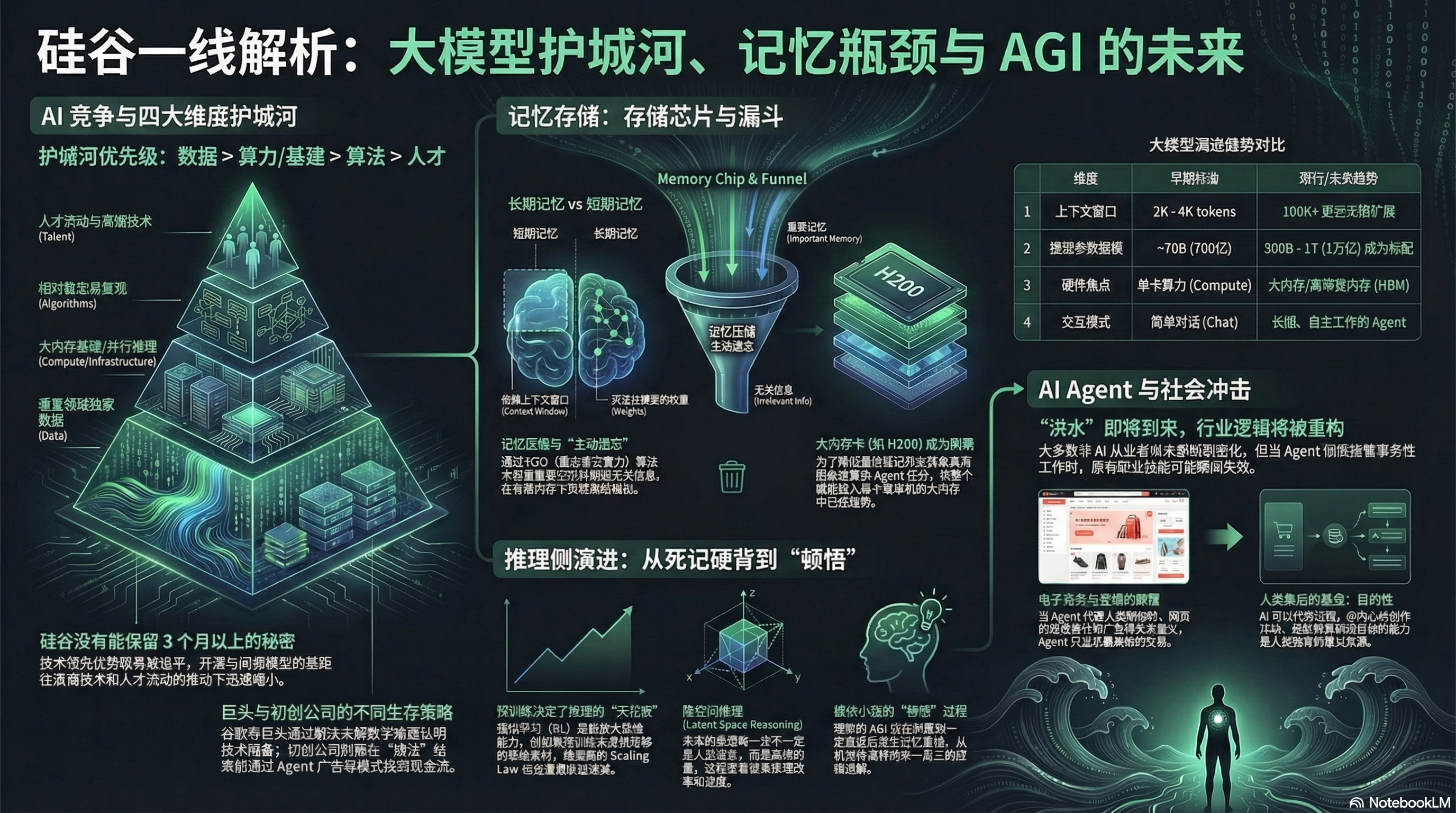
In the elite tiers of AI development, the traditional “moats” of technical algorithms and individual talent have effectively evaporated. Tian describes a phenomenon of “theory flow” within Silicon Valley, where the constant migration of researchers and the rapid dissemination of ideas ensure that any technical advantage has a shelf life of only two to three months.

When forced to rank the pillars of a sustainable moat, Tian prioritizes Data as the primary and most enduring advantage, followed by Infrastructure. Algorithms and talent, once considered the crown jewels of tech, have been relegated to “fluid assets.” This leveling of the playing field is accelerated by distillation—a process where smaller models “harvest” the intelligence of superior models to rapidly close performance gaps. For tech giants like Google or Meta, releasing models is less about protecting a secret and more about a strategic showcase of “talent reserves” and branding to maintain their status in the first tier.

“In Silicon Valley, it’s hard for a secret to be kept for long. Once a new solution is developed, after two or three months, everyone knows a bit about it.”

The “Childhood” of AI Memory—From Rote Learning to Insight

The evolution of Large Language Model (LLM) memory is currently transitioning from a “mechanical” phase to a “logical” one. We are moving beyond the era of simply inflating context windows—a field Tian advanced with his “Position Interpolation” paper—toward sophisticated architectures designed for “active forgetting” and “sublimation.”

Technical milestones like Attention Sink (which maintains continuity by preserving initial tokens) and H2O (Heavy Hitter Oracle) provide the proof of work for this shift. These methods allow a model to maintain a fixed memory capacity while selectively retaining only the most critical information. Tian draws an analogy to his own daughter’s cognitive development: a child initially memorizes numbers through rote repetition, but eventually reaches a moment of “enlightenment” where the internal logic of mathematics is reorganized. At this point, the child moves from “associative memory” (simple mapping) to “grasping the essence” (understanding the big picture). Future AGI will likely mirror this human trait—trading granular, exhaustive data for “sublimated” insight.

“In my vision, the future AGI will have a fixed brain capacity that performs continuous memory sublimation and active forgetting.”

Open Source as “Nuclear Deterrence”

For Tian, the proliferation of open-source AI is not a mere business preference; it is a mechanism for global power equalization. He argues that a world where only a few “closed” labs possess the most powerful models leads to a dystopian class divide.

Open source functions as a form of “nuclear deterrence.” By democratizing high-level calculation and reasoning capabilities, we create a stable balance of power through mutual capability. Within the strategic halls of Meta, the decision to open-source is often a calculated move to demonstrate technical dominance and recruit the world’s top talent. By providing the tools that become the industry standard, they ensure that while the “secrets” flow, the ecosystem remains built on their foundations.

The Death of the Transactional Internet

The rise of AI “Agents”—exemplified by the Xiao Long Xia (Small Lobster) model—threatens to dismantle the trillion-second economy of the transactional internet. Tian distinguishes between “experiential” tasks, which humans enjoy (browsing for inspiration), and “transactional” tasks, which are friction (booking flights, comparing price points).

The efficiency of these agents will soon be supercharged by Latent Space Reasoning (引空间推理). Rather than processing thoughts through slow, human-language tokens, future agents will operate within high-dimensional vectors. This creates a “quantum-like superposition” of multiple thought paths, making inference 10x more efficient. In this world, flashy web design and strategic ad placements are useless; an agent has no human desires and cannot be distracted by a “buy now” button. However, this shift requires a massive leap of faith regarding security, as users must hand over their most sensitive API keys to these digital surrogates.

“It’s like a child holding all your secrets going to the market. They are efficient, but their judgment is still developing. They could easily be deceived into giving away your home address for a piece of candy.”

“Agents will interact with each other to complete work… making phone calls or manual browsing obsolete.”

The “Flood” and the Redefinition of Career Stability

We must stop viewing AI-driven unemployment through the lens of individual failure. The coming “flood” is structural. When AI increases coding efficiency by 10x, the very logic of the labor market shifts. It is not that workers are “bad” at their jobs; it is that the skills they spent decades perfecting have become automated background processes.

In this landscape, the only remaining human territory is Purpose and Internal Impulse (内心的冲动). A machine can generate a painting or a poem with terrifying efficiency, but it cannot possess the motivation to create. The value of human work will shift entirely from the execution of a task to the impulse behind it—the artist’s drive to manifest a vision that the machine, despite its brilliance, cannot value.

“The work’s meaning lies in how humans define that meaning as their own motive. This ‘internal impulse’ is the one thing the machine and the human do not share.”

Conclusion: Beyond the Scaling Law

The industry currently suffers from a “path dependency.” Large labs continue to pour exponential resources—compute, data, and electricity—into the “Scaling Law” because it is a safe, proven trajectory. However, we are approaching a point of diminishing returns where 10x the resources yield only marginal gains. The next leap will not come from more of the same, but from a fundamental shift in how knowledge is represented and stored.

As we automate the friction out of our lives, we face a final, existential question:

When the “transactional” parts of your life are fully automated by agents, what will you do with the “experience” that remains?

交互式分析工具

这是一个交互式的技术分析工具,提供动态数据可视化和深度对比功能。


📱 完整交互式应用


工具特性

该工具包含:

  • 动态图表和可视化
  • 交互式数据对比
  • 实时参数调整
  • 专业的技术分析

上方为完整功能的交互式应用,支持所有动态功能和数据可视化。

0%