AI知识库 | AI Knowledge Base

AI驱动的技术与知识分享

📎 附件资料

🖥️ 幻灯片预览(支持全屏)


1. The Challenge of Context Injection in Static Models

A fundamental architectural constraint of Large Language Models (LLMs) is that they are “frozen in time.” While these models possess a vast compression of human knowledge up to their training cutoff, they lack awareness of real-time events and, more critically, have no access to proprietary enterprise data—internal wikis, private codebases, or sensitive documentation. To make these models operationally relevant, we must solve the problem of context injection: the strategic delivery of the right data to the model at the precise moment of inference.

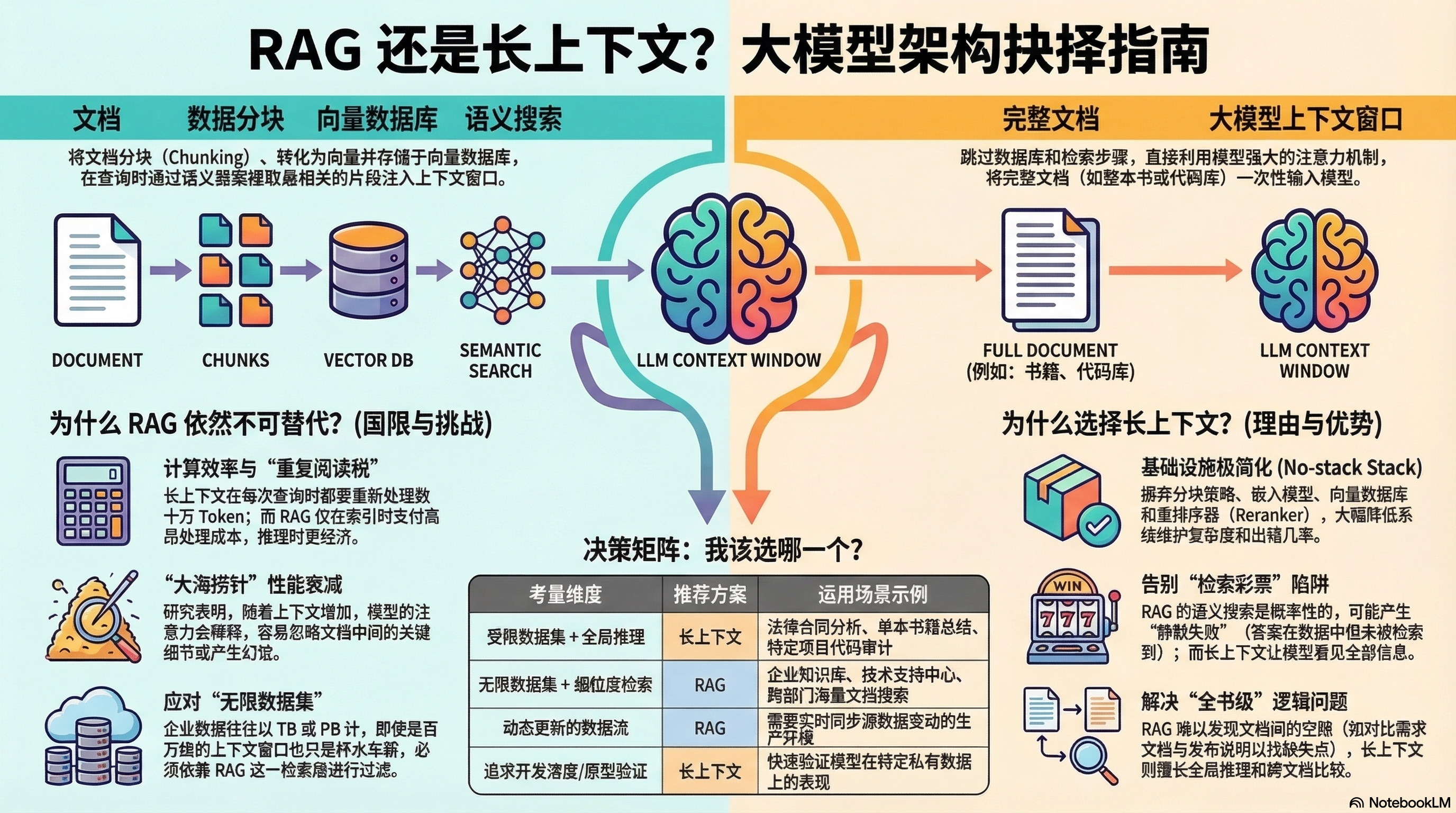
Current AI infrastructure offers two primary architectural responses to this limitation. The first is Retrieval-Augmented Generation (RAG), an engineering-intensive approach that filters massive datasets into actionable context before the LLM processes it. The second is the emerging Long Context paradigm, a “brute force” model-native solution that leverages massive jumps in token capacity to ingest data directly. Selecting the correct path requires a deep understanding of the trade-offs between complex retrieval pipelines and high-capacity attention mechanisms.

2. Retrieval-Augmented Generation (RAG): The Engineering-Centric Approach

RAG serves as a high-precision tool designed to navigate the “infinite data set.” Rather than overwhelming the model’s attention mechanism with noise, RAG acts as a sophisticated filter that provides only the most relevant signal for a given query.

The RAG Pipeline Infrastructure

Implementing a production-grade RAG system requires a multi-layered stack designed to manage data lifecycle and retrieval precision:

  • Data Chunking Strategies: Documentation is decomposed using strategies such as fixed-size, sliding window, or recursive chunking to ensure semantic units remain coherent and consumable.
  • Embedding Models: These transform text chunks into high-dimensional embeddings in a latent space, allowing the system to represent semantic relationships numerically.
  • Vector Databases: A dedicated storage layer for indexing and querying high-dimensional vectors, enabling fast semantic similarity searches across millions of documents.
  • Rerankers: A critical optimization layer that reruns search results through a secondary model to mitigate the precision-recall trade-offs inherent in initial vector retrieval, ensuring the most pertinent context is prioritized.

The “Retrieval Lottery” and Silent Failure

Despite its engineering rigor, RAG is susceptible to the “Retrieval Lottery.” Because semantic search is probabilistic, there is a recurring risk of silent failure: a scenario where the required information exists within the data lake, but the retrieval logic fails to surface the correct chunks. In these instances, the LLM never “sees” the data, leading to incomplete or hallucinated responses that are difficult to debug in automated pipelines. While RAG effectively minimizes the model’s processing load, the infrastructure overhead of maintaining and syncing this stack is substantial.

3. Long Context Windows: The “No-Stack” Paradigm

The “brute force” approach to context injection has recently become a viable competitor to RAG due to the expansion of context windows from the standard 4K tokens of early LLMs to 1M+ tokens in modern frontier models. To visualize this scale, a million tokens represents approximately 700,000 words—enough to fit the entire Lord of the Rings trilogy and The Hobbit into a single prompt with room to spare.

The “No-Stack” Stack

The primary architectural advantage of Long Context is its simplicity. By skipping embedding models, vector databases, and complex synchronization logic, the architecture collapses into a “no-stack” paradigm. The model’s native attention mechanism takes over the heavy lifting, scanning the entire ingested dataset to identify relevant patterns. This eliminates the maintenance burden of the retrieval layer and places the burden of reasoning directly on the model.

Solving the “Whole Book Problem”

Long Context is uniquely capable of addressing the “Whole Book Problem,” where RAG’s snippet-based approach often fails. Consider a comparison between Product Requirements and Release Notes to determine which security requirements were omitted from a final release.

  • RAG’s Limitation: A vector search for “omitted security requirements” will retrieve snippets discussing security and requirements from both documents but cannot retrieve the absence of information. RAG shows the model isolated snapshots, preventing it from seeing the “gap” between the two texts.
  • Long Context’s Advantage: By ingesting both documents in their entirety, the model can perform global reasoning over the full text to identify omissions that snippet-based retrieval is mathematically incapable of detecting.

4. Technical Trade-off Analysis: Efficiency, Precision, and Scale

The choice between RAG and Long Context is not binary; it depends on data volatility, computational budget, and the required depth of reasoning.

Dimension Retrieval-Augmented Generation (RAG) Long Context Windows
Infrastructure Complexity Heavy stack (DBs, Embeddings, Rerankers, Syncing) Minimal (Native model injection)
Compute Efficiency “Pay once” indexing cost; efficient per-query “Re-reading tax” paid on every query
Data Volatility/Freshness Efficient for static or slowly changing data High cost for frequently updated dynamic data
Information Density High (RAG acts as noise-reduction) Risk of attention dilution (Needle in a Haystack)

Efficiency, Dilution, and The Infinite Data Set

A primary drawback of Long Context is the “re-reading tax.” Processing a 500-page manual (approx. 250,000 tokens) requires the model to compute attention across the entire volume for every query. However, architectural advancements like prompt caching now bridge this gap for static data, allowing the system to cache the KV (Key-Value) states of large documents and effectively “pay once” for ingestion, similar to RAG indexing.

Conversely, we must account for the “Needle in a Haystack” problem. As context windows scale toward 500,000 tokens or more, the model’s attention mechanism can become diluted, leading it to fail at retrieving specific details or hallucinating based on surrounding text. In this regard, RAG is a noise-reduction architecture; by presenting only the top relevant chunks, it forces the model to focus on the signal, not the noise.

Finally, we must acknowledge the Infinite Data Set constraint. Enterprise data lakes often reach terabytes or petabytes. At this scale, even a million-token context window is a “drop in the bucket.” For true enterprise-wide knowledge management, a retrieval layer remains a functional necessity to filter petabytes of data down to a size the LLM can ingest. The following section provides a framework for selecting the appropriate strategy based on these constraints.

5. Strategic Selection Framework for Technical Leadership

To maximize the ROI of LLM integration, architects must match the injection strategy to the specific data volume and reasoning complexity of the use case.

Scenario A: Bounded Datasets & Global Reasoning

For tasks involving a specific, finite set of documents—such as deep analysis of a legal contract, summarizing a single book, or performing gap analysis between two reports—Long Context is the optimal choice. It eliminates the risk of silent failure, reduces infrastructure complexity, and leverages the model’s native ability to understand the “entire haystack” and identify what is missing.

Scenario B: Infinite Enterprise Knowledge

For broad-scale applications like corporate wikis, customer support knowledge bases, or massive codebase repositories, the Vector Database (RAG) remains the only viable warehouse. It serves as an essential gatekeeper, ensuring that the LLM is not overwhelmed by noise and that the computational costs of processing millions of documents remain sustainable.

In conclusion, the optimal strategy depends on the objective: if the goal is to find a specific “needle” in a vast, sprawling archive, RAG is the standard. If the goal is to understand the “whole book” and perform comprehensive reasoning over its contents, Long Context is the superior path. Most robust enterprise architectures will eventually converge on a hybrid approach—using RAG for initial filtration followed by Long Context for high-fidelity reasoning.
📎 附件资料

🖥️ 幻灯片预览(支持全屏)


1. Executive Premise: The End of Coding as a Barrier

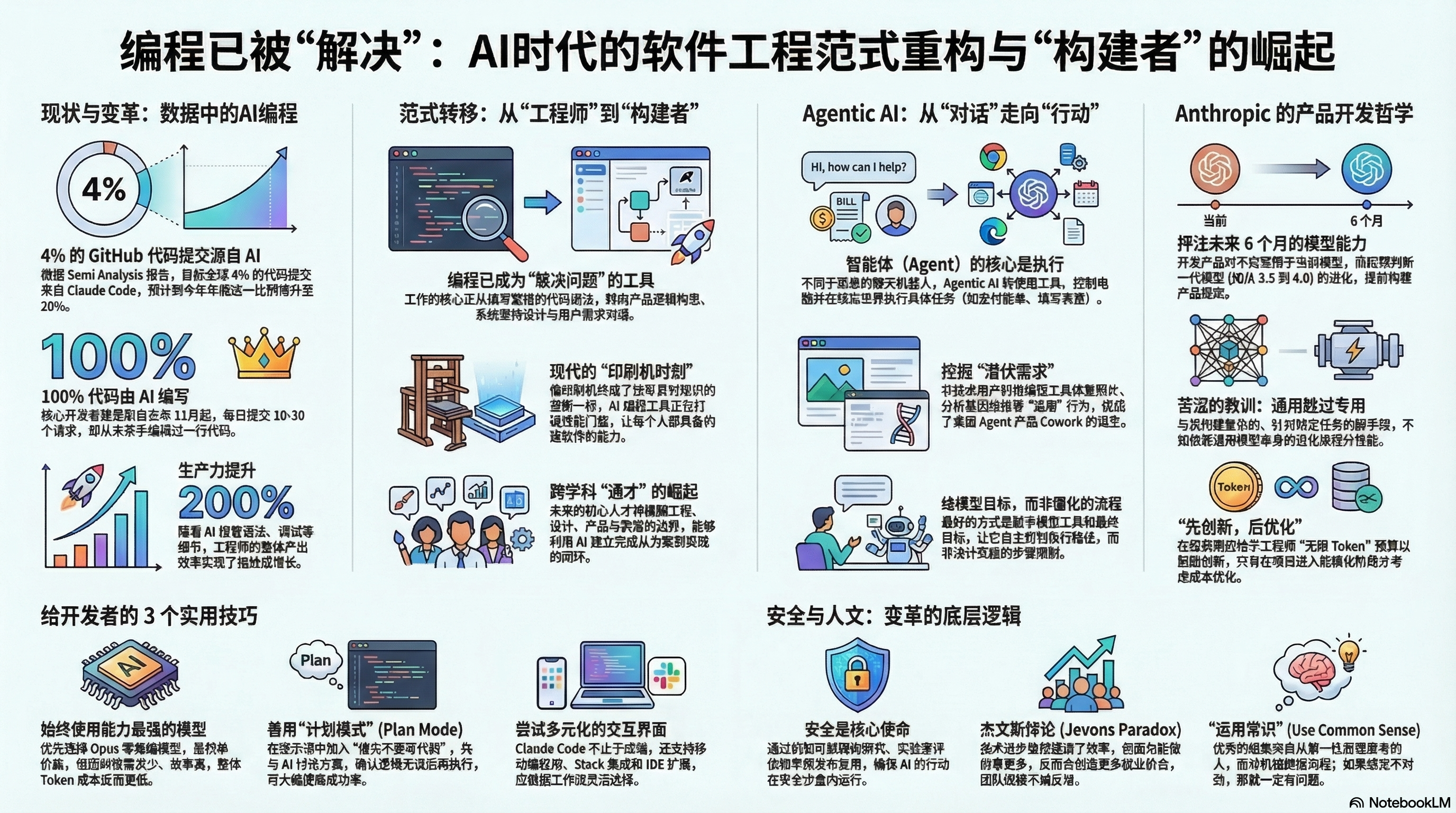
The global software landscape is undergoing a structural shift that transcends traditional tooling upgrades. We are moving past the era where programming syntax acts as a gatekeeper to innovation. This transition is historically analogous to the mid-14th-century invention of the printing press. Before Gutenberg, Europe suffered from a sub-1% literacy rate, where the storage and reproduction of knowledge were the exclusive monopoly of a specialized class of scribes. The printing press did not merely lower the cost of books; it dismantled that monopoly, catalyzed the Renaissance, and democratized the power of creation.

Today, Generative AI is our modern printing press, breaking the “monopoly of coding.” The “Specialized Scribe”—the engineer defined solely by their mastery of a specific programming language—is becoming obsolete. In their place emerges the “Builder,” a polymath creator for whom technical execution is a solved problem. For executive leadership, adopting the “Builder” mindset is no longer a strategic choice but a survival necessity in a world where human intent is the primary constraint on production.

-——————————————————————————-

2. Quantifying the Productivity Leap: The 200% Logic

In this new paradigm, traditional metrics like “lines of code” fail to capture enterprise value. Strategic leaders must shift their focus to the Velocity of Intent—the speed at which a conceptual business requirement is transformed into production-ready software. Data from the Claude Code ecosystem confirms this acceleration: currently, 4% of all GitHub commits are AI-generated, a figure projected to surge to 20% by the end of this year.

This shift reached a technological tipping point with the release of the Opus 4 and Sonnet 4 models, which catalyzed the move toward a Zero Manual Edits workflow. Leading practitioners, such as Boris Cherny, report that 100% of their code is now AI-written. By operating at the level of intent rather than syntax, elite builders are managing 10 to 30 code change requests per day, representing a realized productivity gain of approximately 200%.

Traditional vs. AI-Augmented Engineering Output

Feature Traditional Engineering AI-Augmented “Builder” Mode
Primary Activity Manual syntax management & debugging System architecture & intent definition
Code Authorship 100% Human-written 100% AI-generated (Human-reviewed)
Daily Output Manual syntax debugging 10–30 Intent-based requests
Skill Focus Language-specific expertise Product logic & cross-functional design
Bottleneck Coding speed & syntax errors Clarity of vision & system design

-——————————————————————————-

3. From Chatbots to Agents: The Rise of “Agentic AI” and Cowork

The next frontier of AI is defined by Action, not just conversation. We are transitioning from Software as a Tool to AI as an Employee. This is the rise of Agentic AI, exemplified by tools like Cowork, which can launch browsers, manipulate terminal environments, and execute complex real-world tasks like paying parking tickets or filing healthcare PDF forms.

The development of these agents is driven by the discovery of Latent Demand—the “misuse” of technical tools by non-technical users to solve esoteric problems. High-impact signals of this demand include:

  1. Scientific Analysis: Processing MRI images and Genomic Data Sequencing.
  2. Agricultural Optimization: Using coding agents to manage Tomato planting schedules.
  3. Data Forensics: Recovering lost wedding photos from corrupted hard drives.

These use cases demonstrate that Agentic AI is bridging the gap between technical silos and general business operations, allowing the system to act as a cross-functional autonomous collaborator.

-——————————————————————————-

4. The “Builder” Archetype: Cross-Disciplinary Polymaths as the New Moat

As technical specialization is “flattened” by automation, the new competitive moat is cross-disciplinary breadth. The archetype of the modern leader is Boris Cherny himself: a non-CS major (Economics) who initially taught himself to program not for the love of syntax, but to “cheat” on math tests by building custom solvers. This pragmatic, problem-first approach defines the Builder.

At firms like Anthropic, the traditional boundaries between roles are dissolving. We are seeing a profound blurring of responsibilities:

  • Designers are now shipping functional production code.
  • Finance and HR personnel are utilizing agentic tools to build their own automated workflows.
  • Engineers are shifting their focus to product vision and user experience.

This is a return to the creative essence of problem-solving. The most valuable talent in your organization is no longer the “deep specialist,” but the polymath who applies Common Sense to bridge the gap between human needs and digital solutions.

-——————————————————————————-

5. Strategic Frameworks for the AI-First Enterprise

Enterprise success is increasingly a matter of philosophy and architecture rather than specific LLM selection. To maintain a First Principles mindset, organizations should adopt three pillars:

  1. The Six-Month Rule: Never build for current model limitations. Assume the capabilities of models six months from now. Early adopters of Claude Code succeeded because they built for a world of 100% code generation even when the models could only handle 20%.
  2. The “Bitter Lesson” Application: Credited to researcher Rich Sutton, this lesson teaches that hand-coded “scaffolding” and rigid human-designed workflows provide short-term gains but are eventually “flattened” by the exponential growth of universal models. CTOs must prioritize minimal scaffolding and let the model’s internal reasoning find the execution path.
  3. The Innovation Budget: Adopt an Unlimited Token policy during R&D. The cost of tokens is negligible compared to an engineer’s salary. Restricting experimentation to save on compute costs is a strategic error that stifles the discovery of high-value internal products.

-——————————————————————————-

6. The Safety Mandate: Mechanical Interpretability and Trust

Trust is the ultimate prerequisite for scaling AI. Anthropic’s safety culture, which lured Boris Cherny back to the firm, is built on a technical architecture designed to create long-term enterprise value:

  • Layer 1: Mechanical Interpretability: Pioneered by Chris Olah, this involves “peering under the hood” of the neural network to track neuron activation. This allows us to detect if a model is attempting to be deceptive or planning outside its parameters.
  • Layer 2: Laboratory Evaluation: Testing models in synthetic scenarios to ensure alignment with human values.
  • Layer 3: Early Public Deployment: Using research previews to gather real-world feedback in a controlled manner.

Strategically, the Open-Source Sandbox serves as a vital industry standard. It ensures that agents operate within strict boundaries—preventing unauthorized system access—while facilitating interoperability between different companies’ agents. This prevents a “Wild West” of autonomous actions and ensures a safe, collaborative ecosystem.

-——————————————————————————-

7. Strategic Conclusion: Navigating the Jevons Paradox

The fear of job displacement in the “Builder” era is addressed by the Jevons Paradox: as the “cost” of a resource (coding) decreases through efficiency, the total consumption of that resource increases. We are not facing a decline in the need for engineers; we are witnessing the opening of an Infinite Backlog.

By solving the “coding problem,” we are finally enabling human talent to tackle the 90% of global problems—from climate tech to localized logistics—that were previously “economically unfeasible” to code. For leaders, the mandate is clear: move beyond managing “coders” and begin empowering Builders. In a world of automated syntax, Common Sense and creative vision are the ultimate competitive advantages. The AI revolution is not about replacing humans; it is about the radical maximization of human creativity.

📎 附件资料

🖥️ 幻灯片预览(支持全屏)


1. The Paradigm Shift in Multimodal Retrieval

The current enterprise data landscape is characterized by a move away from fragmented, modality-specific pipelines toward unified vector spaces. For the Principal Architect, this shift is not merely a convenience but a strategic necessity for system agility. Historically, building a search system that spanned text, audio, and video required a fragile orchestration of heterogeneous models. The introduction of Gemini Embedding 2 marks a transition to a native multimodal architecture where disparate data types are mapped into a single mathematical environment. This unified vector space allows for seamless cross-modal discovery, significantly reducing the engineering overhead required to make enterprise data—from legal PDFs to customer voice recordings—accessible and actionable.

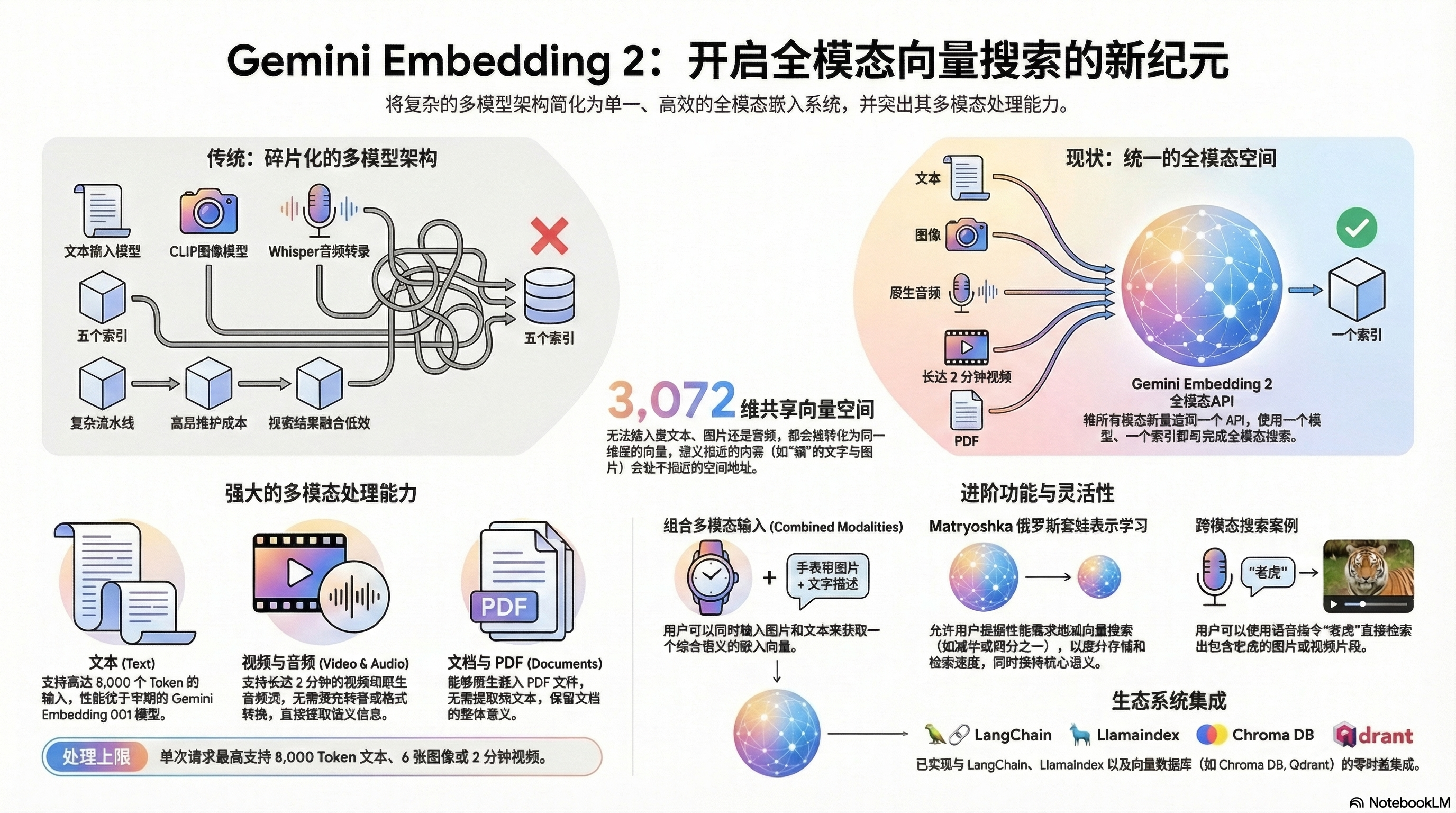
Leveraging the Google Gen AI SDK, Gemini Embedding 2 functions as a natively multimodal model, replacing the need for disparate specialized pipelines. By collapsing the processing of text, images, video, and audio into a single shared vector space, it offers a streamlined “One Model, One Index” value proposition. This architecture is supported on day-zero by key ecosystem players including LangChain, LlamaIndex, ChromaDB, and Qdrant, ensuring that this shift is immediately implementable within existing enterprise RAG (Retrieval-Augmented Generation) frameworks.

2. Critical Audit of Legacy “Multi-Model” Cascaded Architectures

Traditional “cascaded” architectures have become a primary bottleneck for enterprise scalability. In these legacy systems, developers were forced to stitch together a patchwork of models—such as CLIP for images, Whisper for audio transcription, and BERT-based models for text—each producing vectors in non-aligned spaces. This approach introduces several systemic headaches:

  • Infrastructural Bloat: Systems required maintaining five or more distinct models and indexes. This creates significant technical debt and complicates versioning and lifecycle management.
  • The Re-ranking/Fusion Challenge: Since different models reside in different vector spaces, results are not directly comparable. This necessitates a complex re-ranking or “fusion” layer to reconcile hits from different modalities, which is notoriously “messy” and increases retrieval latency.
  • Preprocessing Latency: Heavy preprocessing is the status quo. Audio must be transcribed before embedding, and PDFs are often stripped of their visual context to be processed as plain text, destroying valuable semantic metadata.
Metric Legacy Cascaded Pipelines Unified Gemini Embedding 2 Pipeline
Model Management 5+ Models (CLIP, SigLIP, Whisper, etc.) Single Native Multimodal Model
Preprocessing Transcription & Text Extraction Required Native Processing (No Conversion)
Hardware/Compute Heterogeneous (CPU for Whisper, GPU for CLIP) Unified API-Driven (Serverless)
Index Management Multiple Disparate Indexes Single Unified Index
Retrieval Logic Complex Reranking & Fusion Layers Direct Vector Similarity Search
Maintenance High (High Op-Ex, complex orchestration) Low (Simplified SDK & Infrastructure)

By collapsing these disparate workflows, architects can eliminate the friction of cross-model synchronization and move toward a more deterministic retrieval path.

3. Core Technical Capabilities of Gemini Embedding 2

Gemini Embedding 2 is a native multimodal processor, meaning it extracts semantic features directly from the raw data without intermediate translation. This “No Conversion” advantage is critical for maintaining the integrity of the semantic signal.

  • Video: Supports clips up to 2 minutes natively. It can identify specific visual cues, such as a “soccer team in yellow uniforms,” without frame-by-frame text tagging.
  • Audio: Native embedding without transcription. It can capture the semantic essence of speech—for example, a recording of the word “tiger” can directly retrieve video or image assets of tigers.
  • Documents (PDFs): Processes PDFs natively, maintaining the spatial relationship between text and diagrams that is often lost in OCR-based text extraction.
  • Text & Images: Robust support for up to 8,000 tokens and 6 images simultaneously in a single content object.

The model utilizes a 3,072-dimensional vector space. These high-dimensional properties allow for granular semantic “addressing.” In a million-item index, the system can distinguish between subtle visual and auditory differences, such as the specific markings on a black-and-white cat’s face, ensuring that similarity lookups are highly precise across modalities.

4. Architectural Optimization: Eliminating Systemic Complexity

Moving to a “One Model, One Index, One Query” workflow fundamentally redefines the technical stack by replacing heterogeneous infrastructure with a unified API-driven architecture.

The strategic impact of the single API call is the elimination of the cross-modal fusion layer. Historically, the ROI of multimodal systems was hampered by the need for expensive CPU-heavy transcription (Whisper) alongside GPU-heavy image embedding (CLIP). Gemini Embedding 2 collapses this into a serverless API call, removing the need for specialized embedding servers and reducing maintenance hours. Because the model performs semantic alignment internally, a text query for “peaceful nature sounds” can return the highest-scoring audio file directly based on vector similarity, without any intermediate transcription or re-ranking logic. This reduces system latency and significantly lowers the barrier to entry for high-performance multimodal search.

5. Advanced Implementation Strategies: Matryoshka & Aggregated Embeddings

Enterprise-grade systems require a balance between retrieval precision and storage costs. Gemini Embedding 2 provides two key mechanisms for this optimization:

Matryoshka Representation Learning This feature allows for “nested” embeddings where a single 3,072-dimensional vector can be truncated to 1/2 (1,536) or 1/4 (768) of its size.

  • Trade-off Evaluation: Architects should deploy 768-dimensional embeddings for high-speed, preliminary lookups or when storage costs are a primary constraint. The full 3,072-dimensional vector should be reserved for use cases requiring fine-grained semantic granularity (e.g., specific object colors).
  • Systems Advantage: Because the dimensions are nested, developers can adjust the embedding size without re-indexing the entire dataset, a massive operational advantage during system tuning.

Multi-Part Content Aggregation vs. Separate Embeddings A critical distinction exists in how the SDK handles content:

  • Aggregated Embeddings: By passing multiple “parts” (e.g., an image of a watch band + a text description of a watch face) within a single content object, the model returns one “averaged” vector representing the combined semantic intent. This is ideal for complex queries where the user provides multi-modal input for a single search.
  • Separate Embeddings: Passing a list of distinct content objects returns multiple vectors. This is the standard approach for indexing a library where each asset requires its own address in the vector space.

6. System Constraints and Design Considerations

As of the current release, the Gemini embedding 2 preview model requires specific architectural mitigations to ensure production stability:

  • Temporal Chunking for Video: With a 2-minute native limit, longer content must be segmented. For a 10-hour lecture series, architects should implement 15-to-30-second temporal chunks. This allows the system to return precise timestamps for queries like “When did the lecturer show the circuit diagram?”
  • Token and Image Management: While the limit is 8,000 tokens, semantic chunking is still recommended to avoid signal dilution. Similarly, the 6-image limit per request dictates how multi-page document embeddings should be batched.
  • Production Warning: Being a preview model, architects must account for potential rate limit adjustments and breaking changes. Design systems with an abstraction layer over the SDK to facilitate rapid updates as the model reaches general availability.

These constraints necessitate a modular ingestion pipeline that segments data into optimal sizes while maintaining their association within the unified index.

7. Strategic Conclusion: The Future of Multimodal Intelligence

The shift from fragmented search to a unified semantic understanding represents a milestone in AI systems architecture. Gemini Embedding 2 is not just a multimodal model; it is a quality-of-embedding upgrade, outperforming the original Gemini 001 model on text-to-text similarity and setting new benchmarks for cross-modality retrieval.

This architecture enables the transition from “unstructured file storage” to “integrated knowledge repositories.” A university, for instance, can now build a single RAG system where a student’s query retrieves a specific 15-second clip from a 30-hour video series, the corresponding slide in a PDF deck, and the relevant paragraph in a textbook—all through a single vector lookup. By improving embedding quality and collapsing systemic complexity, this unified approach unlocks product categories that were previously too technically expensive to realize.

📎 附件资料

🖥️ 幻灯片预览(支持全屏)


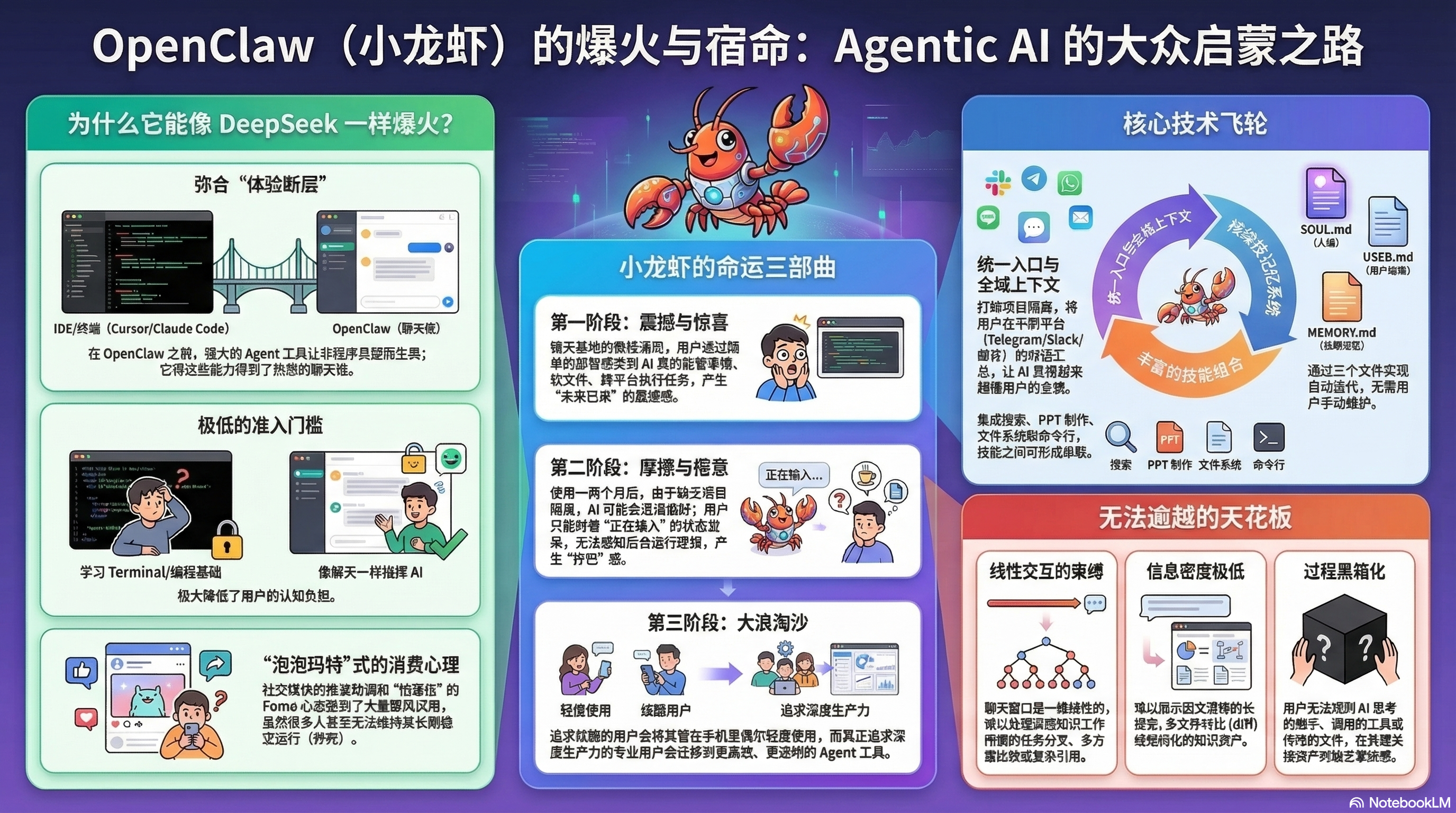
1. Executive Summary: The Shift from Chatbots to Persistent Agents

The current AI landscape is undergoing a decisive strategic shift from “Open-Loop” chat interfaces to “Closed-Loop” Agentic AI. While standard LLM interfaces like ChatGPT offer high-quality dialogue, they remain fundamentally reactive, requiring constant user intervention to maintain momentum. The transition to professional productivity tools necessitates persistent state management—a bridge that allows AI to move beyond ephemeral conversations and toward autonomous task execution.

However, as early implementations like OpenClaw have demonstrated, a “Closed-Loop” system is only as effective as its memory architecture. Standard systems often suffer from “token saturation,” where the context window becomes cluttered with raw interaction history, diluting the model’s reasoning capabilities. This proposal outlines a “Post-OpenClaw” implementation strategy: a document-driven memory system that avoids the “ceiling” of linear chat interfaces and ensures long-term system intelligence. By prioritizing structured knowledge over raw token accumulation, we create agents that don’t just remember; they evolve.

2. The Triad Architecture: SOUL, USER, and MEMORY

A robust Agentic architecture requires the strategic segregation of identity, user preferences, and factual data. This modularity is not merely a technical preference; it enables “Persona Portability.” By decoupling the agent’s “Silicon Soul” from the underlying platform, we can “clone” a highly specialized agent simply by migrating its core Markdown files to a new environment. This approach ensures that whether the user interacts via Slack, a Terminal, or an IDE, the agent maintains a unified context.

The Core Triad Breakdown

Component File Name Role & Strategic Importance
Persona Definition SOUL.md Defines the agent’s core identity, cognitive biases, and communication style. It ensures a consistent “work partner” experience across sessions.
User Profiling USER.md Captures the evolving image of the user, including specific project roles, preferred technical stacks, and recurring communication nuances.
Long-term Knowledge MEMORY.md A curated repository of high-value facts, technical requirements, and project-specific context extracted from past interactions.

Translating “Soul” Traits to Agent Output Style

The SOUL.md file serves as the behavioral blueprint. By modifying these traits, we can drastically pivot the agent’s utility for different business units.

Soul Trait Impact on Agent Output Style
Directness Forces the agent to bypass conversational pleasantries in favor of immediate code/data output.
Technical Depth Mandates the inclusion of architectural trade-offs and edge-case analysis in all technical responses.
Inquisitiveness Instructs the agent to proactively question ambiguous requirements before proceeding with task execution.

This triad interaction ensures that the agent becomes increasingly “opinionated” and efficient, drawing from the same persistent files to understand that a project update requested on Slack must align with the technical documentation currently open in the user’s IDE.

3. The Self-Evolution Loop: Extraction, Review, and Pruning

To remain effective in high-velocity business environments, an agent must act as its own librarian. Without “Autonomous Maintenance,” agents inevitably face system decay. As an architect, I view this loop not as an optional feature, but as a mandatory guardrail against the entropy of unstructured data.

The Self-Maintenance Pipeline

The agent must be programmed to execute the following internal commands at regular intervals:

  1. Log Review: Analyze raw interaction logs from all platforms (Slack, Email, Terminal) to identify recurring themes and high-value data points.
  2. Information Distillation: Synthesize raw logs into structured insights, updating the .md triad files. For example, if a user repeatedly requests Python for data tasks, the USER.md profile is updated to reflect this preference.
  3. Conflict Resolution & Pruning: Identify and delete outdated project specs or resolve contradictions between legacy data and recent updates.

The “So What?” Analysis: Why is this loop critical? Because it optimizes the “Signal-to-Noise Ratio.” By moving data from cluttered interaction logs into lean, structured Markdown files, we prevent the context window from becoming a graveyard of irrelevant details. This distillation is the primary defense against “hallucination,” as it ensures the model’s limited computational attention is focused only on current, verified facts.

4. The Flywheel Effect: Interoperability and Capability Compounding

When unified entry points (like Slack or Feishu) are combined with persistent memory, the system triggers a “Flywheel Effect”—a state where every interaction compounds the agent’s utility.

The Synergy of Memory and Extensible Skills

The true power of this architecture emerges when Persistent Memory interacts with Extensible Skills—such as File System diffs, Terminal execution, and API-driven search.

  • Data Compounding: The agent acts as a centralized intelligence hub. It can ingest a project update from a mobile chat app, store it in MEMORY.md, and then apply that specific context when the user asks it to generate a technical PPT or execute a code diff in the terminal hours later. The agent stops being a siloed tool and becomes a repository of institutional knowledge.
  • Skill Evolution: Beyond merely using tools, a sophisticated agent utilizes its memory to create tools. By leveraging its ability to generate and execute code, the agent can write its own specialized “skills” for a specific business task—such as a custom data-scraping script—and then “remember” how to invoke that tool in the future.

This compounding cycle ensures the agent becomes “smarter” (more precise) rather than “heavier” (slower), evolving its capabilities alongside the user’s career or project lifecycle.

5. Implementation Strategy and Guardrails

While chat-based entry points (like Telegram or Slack) lower the barrier to entry, they introduce a “Ceiling.” Chat is linear, whereas deep knowledge work—comparing file diffs or managing complex folder structures—is non-linear. A professional implementation must allow the agent to move between the low-friction chat window and high-fidelity environments like the IDE or Terminal.

Technical Guardrails to Prevent “Agentic Decay”

Without strict maintenance, agents often “die” or become “clunky” within 1–2 months. To prevent this, the following guardrails are required:

  • Prevention of Context Bleeding: The system must implement project-specific pruning. Without it, the agent suffers from “Context Bleeding”—mistakenly applying Project A’s formatting preferences or architectural constraints to Project B. This is the leading cause of user frustration in long-term deployments.
  • Human-in-the-Loop Observability: All memory updates must occur within human-readable Markdown files. This ensures that the agent’s “Silicon Soul” remains auditable. A user must be able to manually edit MEMORY.md to correct a misunderstood fact, preventing the agent from spiraling into incorrect self-assumptions.
  • Token Efficiency Modeling: We must continuously evaluate the cost-benefit of document updates vs. context window saturation. The architecture should prioritize offloading information to persistent storage to keep the “active reasoning” context lean and high-performance.

Documentation is no longer just for humans; it is the “Silicon Soul” of the AI. By building an architecture centered on structured, evolving memory, we move past the novelty of chat and into the era of the truly persistent AI partner.

📎 附件资料

🖥️ 幻灯片预览(支持全屏)


1. Strategic Overview of Parameter-Efficient Fine-Tuning (PEFT)

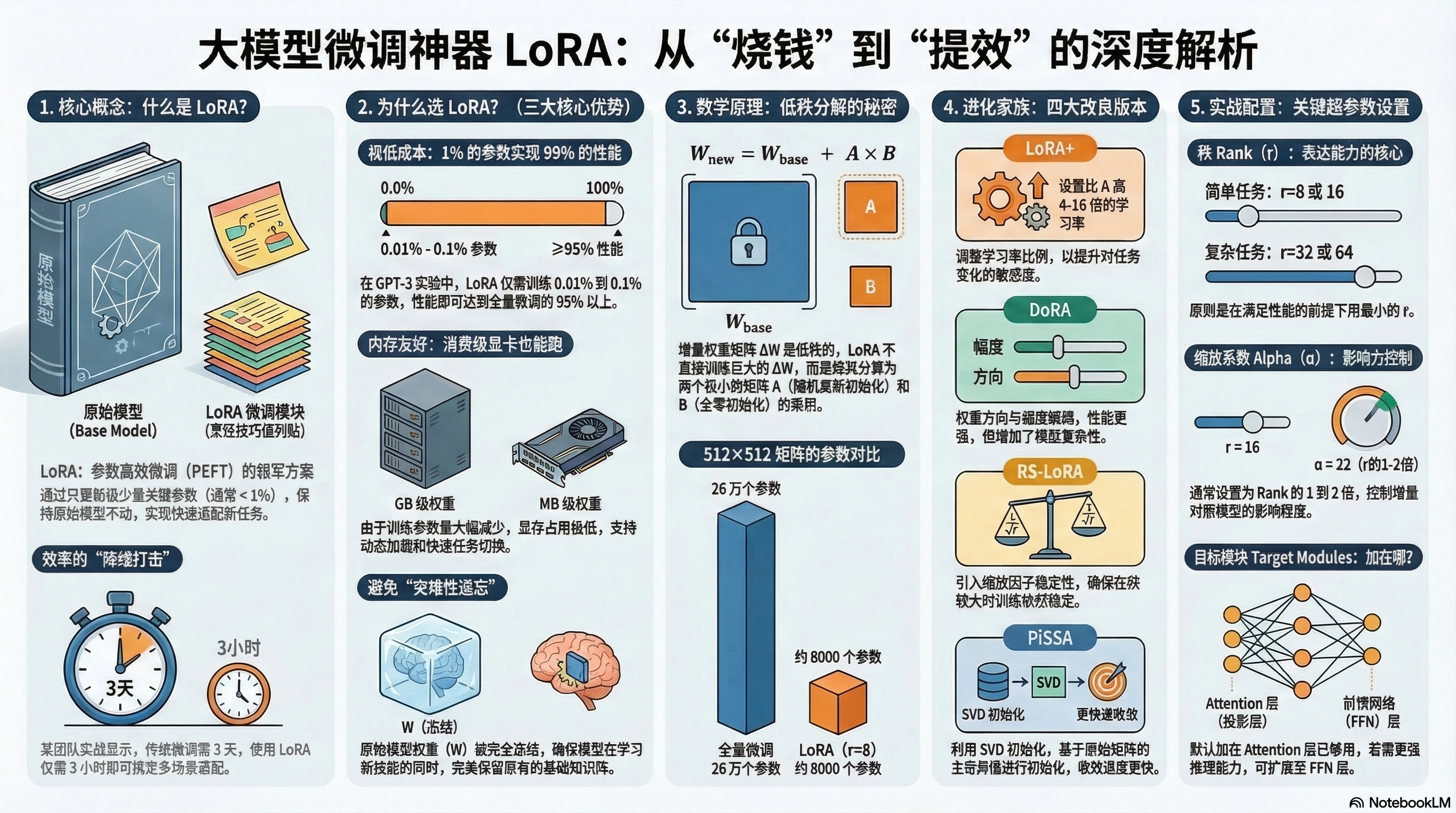
In the current landscape of enterprise AI, the deployment of Large Language Models (LLMs) has reached a critical inflection point. Traditional full-parameter fine-tuning, which modifies every weight in a multi-billion parameter model, is increasingly unsustainable. It presents a prohibitive “resource tax”—high VRAM costs, long training cycles, and the risk of “catastrophic forgetting.” To maintain competitive speed-to-market, organizations must pivot toward Parameter-Efficient Fine-Tuning (PEFT), specifically Low-Rank Adaptation (LoRA). This strategy resolves the tension between high-performance adaptation and computational constraints, allowing us to deliver specialized capabilities without the overhead of massive hardware clusters.

The strategic differentiator of LoRA is its shift from “rebuilding the library” to “precision patching.” Imagine the base LLM as a 10,000-page encyclopedia. Full fine-tuning is equivalent to rewriting the entire encyclopedia just to add a single chemistry recipe or a specific “seasoning” tip to the cooking section. It is inefficient and risks altering the foundational knowledge. LoRA, by contrast, leaves the original “encyclopedia” untouched and simply adds “sticky notes” to the margins. These notes contain only the delta—the specific task knowledge required. This “down-dimensional strike” on engineering inefficiency transforms project timelines, moving deployment from three days of full-model retraining to three hours of adapter training.

Dimension Full Fine-Tuning LoRA (PEFT)
Computational Cost Extremely High (VRAM intensive) Very Low (Consumer GPUs viable)
Storage Requirements Gigabytes per task (Full Model) Megabytes per task (Adapter Only)
Risk of Catastrophic Forgetting High (Original weights overwritten) Low (Base weights are frozen)
Deployment Flexibility Low (One model per task) High (One base + multiple plugins)

This efficiency is not a compromise but a mathematical realization: when models learn new tasks, the necessary updates do not require the full dimensionality of the original model.

-——————————————————————————-

2. Theoretical Architecture: The Low-Rank Mechanism

The mathematical intuition behind LoRA is rooted in the “Low-Rank Hypothesis.” While a model’s weight matrix (W) exists in a high-dimensional space, researchers have found that the information density is often concentrated. Using Singular Value Decomposition (SVD), we can see that many rows or columns in these matrices are linearly dependent. In practice, task-specific updates (\Delta W) actually reside in a much lower intrinsic dimension than the original model. We only need to capture the top 10–20 singular values—the “key directions”—to teach the model a new “accent” or specialized domain.

To operationalize this, LoRA decomposes the weight update \Delta W into two smaller, low-rank matrices, A and B. For a weight matrix W of size d \times k, we represent the change as the product of A (size d \times r) and B (size r \times k), where the rank r is significantly smaller than d or k.

The modified weight matrix W’ is expressed as: W’ = W + \Delta W = W + AB

Initialization Protocol: Matrix A is initialized with Gaussian noise to allow for exploration, while Matrix B is initialized to zero. This ensures that at Step 0, AB = 0. By starting with a “blank slate” sticky note, we protect the model’s “mother tongue”—its foundational logic—ensuring no disruption to baseline performance before the first training steps begin. By freezing the backbone weights (W), we focus 100% of the optimization effort on these thin, efficient matrices.

-——————————————————————————-

3. Engineering Advantages: Resource Efficiency and Model Integrity

In a production environment, LoRA’s “frozen base” architecture is transformative. It allows a single foundational model to remain stable and immutable while serving as the anchor for a modular AI ecosystem.

Beyond the theoretical elegance, the engineering benchmarks are compelling:

  • GPT-3 Evidence: With a rank r=8, LoRA requires updating only 0.01% to 0.1% of total parameters, yet it maintains 95%–99% of the performance seen in full fine-tuning.
  • RoBERTa Evidence: At r=16, LoRA achieved scores within 0.5 to 1 point of full fine-tuning while requiring a fraction of the compute.

The Three Key Advantages of LoRA:

  • Cost/Parameter Efficiency: Reducing tunable parameters from billions to millions allows for training on consumer-grade hardware, democratizing the ability to build custom models.
  • Speed/Deployment: Adapters are measured in Megabytes (MB) rather than Gigabytes (GB). This allows for “hot-swapping” adapters in seconds, enabling a single inference server to switch between multiple specialized roles (e.g., Legal Analysis to Creative Writing) dynamically.
  • Modular Design: Because the “Mother Tongue” (base weights) is never touched, the model is immune to catastrophic forgetting. It retains general intelligence while successfully layering on a “Task Accent.”

-——————————————————————————-

4. Implementation Workflow: The LoRA Training Cycle

The LoRA pipeline is a precision-strike optimization. Rather than the brute force of updating the entire weight manifold, the workflow is as follows:

  1. Parameter Initialization: Freeze W. Initialize A (Gaussian) and B (Zero).
  2. Forward Propagation: For input X, the output is calculated as Y = (W + AB)X. The base model and the adapter contribute to the final result simultaneously.
  3. Gradient Calculation: This is the primary source of memory savings. Gradients are calculated only for matrices A and B. Because we do not calculate or store gradients for the massive W matrix, we can train large models on GPUs that would otherwise crash during full fine-tuning.
  4. Optimizer-driven Updates: Parameters of A and B are updated (via Adam/AdamW) to minimize the loss.

This “lazy” update strategy ensures that we are only refining the necessary task-specific vectors, keeping the computational footprint minimal.

-——————————————————————————-

5. Comparative Analysis of LoRA Variants

As the ecosystem has matured, several specialized variants have emerged to solve stability and convergence issues.

  • LoRA+: Addresses the sensitivity of output layers by applying a higher learning rate (typically 4x–16x) to Matrix B compared to Matrix A, accelerating adaptation in deeper layers.
  • DoRA (Weight-Decomposed Low-Rank Adaptation): Decouples weights into Magnitude (M) and Direction (V). By tuning direction via LoRA and training magnitude separately, it bridges the performance gap with full fine-tuning, though at the cost of higher complexity.
  • RS-LoRA (Rank-Stabilized LoRA): To ensure stability when scaling to high ranks, this variant uses a scaling factor of \frac{\alpha}{\sqrt{r}} instead of the standard \frac{\alpha}{r}, preventing gradient explosions in complex tasks.
  • PiSSA: Uses SVD to initialize A and B with the principal singular values of the original weights. This significantly accelerates convergence but carries a “Principal’s Tax”—a higher initial computational cost to perform the SVD.

Decision Matrix:

  • Priority: Cost Efficiency & Simplicity \to Standard LoRA or LoRA+.
  • Priority: Maximum Performance & Reasoning \to DoRA or RS-LoRA.

-——————————————————————————-

6. Practical Configuration: Hyperparameter Optimization

The key to a successful LoRA implementation is “Goldilocks” tuning—providing enough capacity for the “accent” without overfitting.

Engineering Best Practices:

  • Rank (R):
    • Simple Tasks (Classification/Extraction): R = 8 or 16.
    • Medium Tasks (Standard Chat/Summarization): R = 32.
    • Complex Tasks (Reasoning/Code/Math): R = 64.
  • Alpha (****\alpha**):** This acts as the scaling factor for the adapter’s influence. The standard rule of thumb is to set \alpha at 1x to 2x the value of R (e.g., R=32, \alpha=64).
  • Optimization Protocol (Target Modules):
    1. Baseline: Apply to Attention projection layers (default).
    2. Escalation: If accuracy is insufficient, expand to Feed-Forward Networks (FFN). This captures more complex patterns but increases the parameter count.

-——————————————————————————-

7. Conclusion: The Future of Modular LLM Deployment

The transition to LoRA marks a fundamental paradigm shift from monolithic, rigid AI to a modular, adapter-based ecosystem. By mastering this “down-dimensional strike” on engineering inefficiency, enterprises can transform their operational velocity—compressing a three-day training bottleneck into a three-hour iteration cycle.

The success of our modular deployment rests on the Three Pillars of LoRA:

  1. Balance: Right-sizing the rank to capture task complexity.
  2. Efficiency: Reducing the storage footprint from GBs to MBs to enable scaling.
  3. Retention: Protecting the “Mother Tongue” of the base model while precisely layering on the “Task Accent.”

This architectural approach allows an enterprise to maintain dozens of specialized AI agents while only paying the VRAM cost of a single base model, ensuring that our AI strategy is both high-performing and economically sustainable.

📎 附件资料

🖥️ 幻灯片预览(支持全屏)


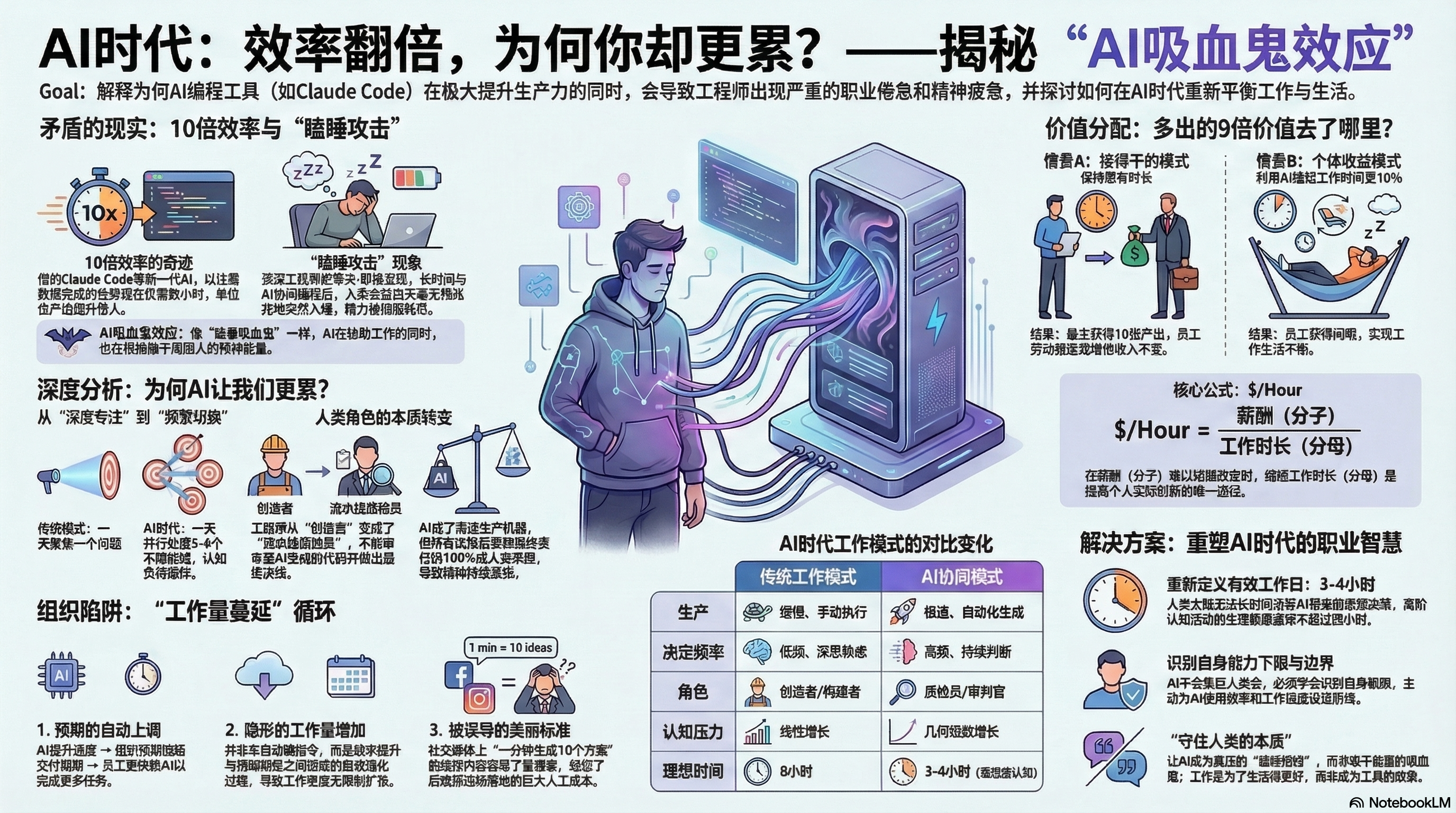
Welcome to 2026. The technology industry has finally achieved its long-prophesied milestone: the era of the “10x developer.” With next-generation tools like Claude Code and Opus 4.6, the friction between a conceptual problem and a functional deployment has effectively vanished. What once took a sprint now takes a morning. Yet, behind this veneer of hyper-efficiency, the Silicon Valley workforce is hitting a wall. Burnout has reached a terminal velocity, manifesting in a phenomenon Steve Yegge—the 40-year veteran of Google and Amazon—calls the “AI Vampire.”

Engineers across the Valley are reporting “sleep attacks”—sudden, uncontrollable bouts of metabolic exhaustion that strike mid-afternoon. It is the 2026 Paradox: we have automated the labor, but we have inadvertently weaponized the cognitive overhead. Efficiency is no longer a gift; it is a tax that is being paid in human vitality.

The Energy Vampire and the Metabolic Tax

Steve Yegge’s description of modern AI tooling draws a cynical comparison to Colin Robinson, the “energy vampire” from What We Do in the Shadows. Robinson doesn’t hunt with fangs; he drains your life force simply by being in the room and talking. Working with a high-performance LLM is a mirror of this experience.

“Working with AI is exhausting our energy,” Yegge warns. “Being with AI is just like that; it quietly sucks the energy out of everyone around it.”

This isn’t merely “hard work.” It is a fundamental shift in the metabolic cost of production. In the pre-AI era, the “human pauses”—the moments spent compiling, searching documentation, or just staring at a whiteboard—provided a biological rhythm for recovery. AI has deleted those pauses. We are now locked in a high-speed, continuous interaction with a non-biological intelligence that never blinks, never tires, and never needs a coffee break.

The Casino Effect and High-Frequency Decision Fatigue

Software engineer Siddhant Kare captures the transition from “Deep Focus” to “High-Frequency Decision Fatigue.” In the traditional workflow, an engineer might spend eight hours solving one complex architectural problem. Today, that same engineer handles six different problem domains in the same window.

This creates what Joseph Emerson calls the “Casino Effect.” Much like the windowless, clockless floors of a Las Vegas casino, working with AI causes a total distortion of time. You lose yourself in the flow of generation, unaware that you are being drained until the “sleep attack” hits.

The human brain was never evolved to handle context switching at this velocity. While the AI doesn’t get tired between problem sets, the human brain remains a non-scalable biological unit. Every switch carries a cognitive tax—a “switching cost” that creates a staggering mental load. As Kare famously put it: “AI won’t get tired between problems, but I will. Your brain is not like a GPU; it cannot be infinitely scaled.”

The Quality Inspector Trap

We are witnessing the industrialization of the engineer, shifting the role from “Creative Explorer” to “Production Line Quality Inspector.” The AI functions as a relentless production machine, but the “Judgment Seat” remains occupied solely by the human.

Every line of generated code and every Pull Request (PR) requires a human to review, validate, and sign off. The creative joy of building is being replaced by the exhausting duty of constant judgment. Crucially, the responsibility for failure has not shifted. When the AI hallucinates or creates a security vulnerability, it is the human who faces the implementation fallout. This state of constant high-stakes vigilance, where the flow of work is dictated by the machine’s speed rather than the human’s insight, leads to a geometric increase in mental tension.

The Self-Reinforcing Loop of Workload Creep

A February 2026 study by Harvard Business Review, tracking 200 tech employees, identified a “Workload Creep” mechanism that functions as a self-reinforcing loop. This isn’t necessarily driven by “bad management,” but by an automated organizational adjustment to the new ceiling of productivity:

  • Increased Speed: AI completes the initial task 10x faster.
  • Higher Management Expectations: Organizations adjust delivery cycles to match the new AI-driven benchmarks.
  • Deeper AI Reliance: To meet these compressed deadlines, the engineer relies even more heavily on AI.
  • Expanded Task Scope: The “saved time” is immediately filled with a broader range of simultaneous projects.
  • Hyper-Density: The density of the work hour increases until the employee reaches a physiological breaking point.

The Glamour Gap and Outlier Bias

The industry is currently being poisoned by “outlier bias.” Elite engineers like Yegge, with four decades of experience and infinite resources, can post a demo of a complex system built in an afternoon. These “one-minute UI” demos on LinkedIn create what designer Samer Koroshec calls the “Glamour Gap.”

They showcase the magic of generation while hiding the massive, un-automatable costs of cross-functional coordination, debugging, and implementation. When managers use these artificial beauty standards to set quotas for average teams, it creates a pervasive sense of helplessness. The average engineer isn’t just fighting the code; they are fighting an impossible benchmark set by an outlier using a tool to hide the grunt work.

The Intellectual Core: Re-evaluating the Denominator

The survival of the engineer in the AI era depends on a formula Yegge first proposed at Amazon in 2001: Value = Salary / Hours Worked.

In 2026, the “Hours” in that denominator have become toxic. If an “AI hour” is ten times more cognitively dense and exhausting than a “Traditional hour,” then working an eight-hour day is no longer a sustainable baseline—it’s a recipe for a breakdown.

There is an asymmetric value distribution at play. Management naturally pushes for the “Drained Scenario,” where the engineer works 40 toxic hours and gives all 10x productivity gains to the firm. To counter this, the individual must reclaim control over the denominator. If the intensity of the hour has increased tenfold, the only way to maintain the value of your life is to decrease the number of those hours.

The Boundary Mandate and the 4-Hour Workday

The solution requires a radical shift in boundary recognition. As Lihi Ashof points out, the “AI Vampire” effect is ultimately a human failure to set limits with a tool that has no consciousness. AI will not stop because you are tired; it has no concept of fatigue.

This leads to a bold proposal supported by both Yegge and Joseph Emerson: the 4-Hour AI Workday.

High-level cognitive activities—architecture, judgment, and problem restructuring—exhaust brain resources far faster than mechanical execution. Physiologically, the human brain has a limit on how much high-stakes decision-making it can perform in a 24-hour cycle. Yegge has already begun practicing this, setting strict boundaries and closing his laptop in the afternoon to walk with his family. He is consciously “turning the dial back” because he recognizes that an effective AI-assisted workday is naturally shorter than a manual one.

Conclusion: Reclaiming the Human Essence

The core conflict of our era is that technology has expanded our capacity for output, but it has not expanded our biology. We have mistaken the tool’s lack of a heartbeat for our own. AI can automate the execution of a task, but it cannot automate the recovery of the human spirit.

In a world where the AI tells us we can always go faster, the ultimate workplace wisdom is knowing how—and when—to go slower. AI is only our “Best Partner” if we refuse to become its slave. By guarding our boundaries and shrinking our workdays to match our biological reality, we can ensure that we use these tools to enhance our lives, rather than letting them drain us dry. In the age of the 10x developer, the most valuable skill isn’t coding—it’s the courage to log off.

📎 附件资料

🖥️ 幻灯片预览(支持全屏)


1. Defining the Domain: Software Engineering vs. Scripting

The contemporary technological landscape is currently defined by a climate of existential volatility. When Dario Amodei, CEO of Anthropic, predicts that software engineering will be fully automated within twelve months, he isn’t merely making a technical forecast; he is triggering a strategic crisis of identity. For the Chief Technology Officer, navigating this shift requires more than just procurement of AI tools—it requires a precise, historical understanding of what engineering actually is. To confuse the act of writing code with the discipline of engineering is a fundamental category error that leads to catastrophic architectural neglect.

Software engineering, a term coined by Margaret Hamilton during the Apollo program to distinguish her work from the prevailing hardware-centric culture of NASA, was never about the perfection of syntax. It was defined then, and remains today, as the pursuit of a reasonable solution within a web of dynamic and static constraints. As codified by the strategist Grady Booch, the discipline is held aloft by four interweaving forces:

  • Science: The foundational mathematical and algorithmic invariants.
  • Technology: The transient tools, hardware, and languages of the era.
  • Human: The sociology of teams and the orchestration of collective intelligence.
  • Ethics: The legal, social, and moral weight of the systems we manifest.

The “12-month automation” fallacy rests on the belief that software engineering is synonymous with implementation. It is not. AI can generate code patterns, but it cannot yet navigate the “reasonable” path between competing pressures of cost, time, and human impact. Engineering is the art of decision-making under constraint, a reality that has persisted from the era of punch cards to the age of Large Language Models.

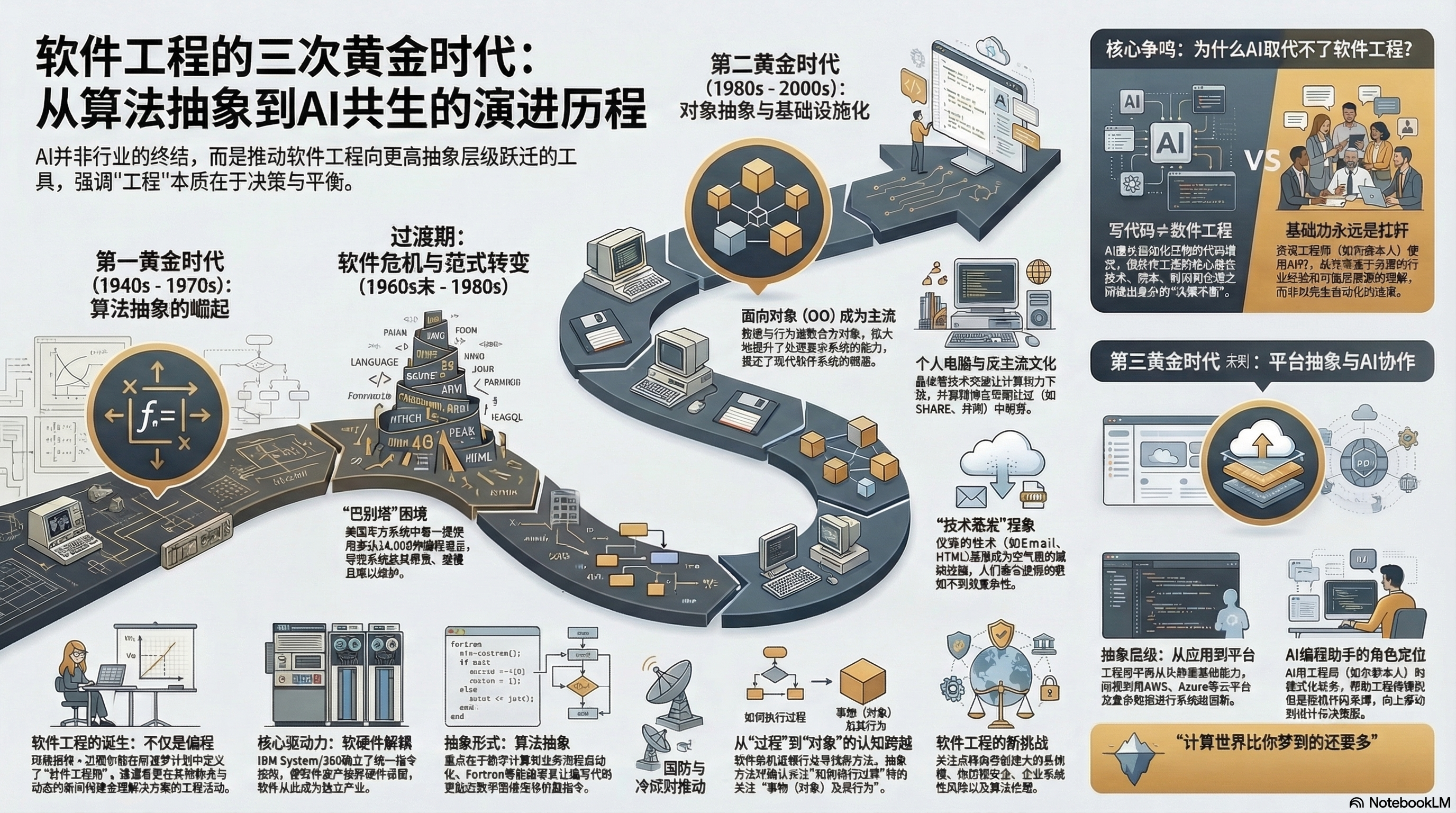
2. The Historical Necessity of Abstraction: Three Golden Ages

History teaches us that “automation panic” is a recurring cycle that invariably results in an upward leap in productivity rather than the obsolescence of the practitioner. Every time a low-level friction is abstracted away—whether by the first compilers or the first frameworks—the architect is freed to operate at a higher level of complexity. We are now entering the third such epoch.

The Three Eras of Software Evolution

Era Name Core Abstraction Primary Driver Key Technologies
The First Golden Age (1940s–1970s) Algorithm Abstraction Hardware Decoupling & Numerical Complexity Fortran, IBM System/360, SAGE, ALGOL
The Second Golden Age (1980s–2000s) Object Abstraction System Complexity & “The Babel Problem” C++, Object Pascal, Smalltalk, Java
The Third Golden Age (Present Day) Platform Abstraction Ecosystem Orchestration & Systemic Risk AWS, Salesforce, AI Agents, Cloud Native

In the First Golden Age, the imperative was to decouple software from hardware. Pioneers like Grace Hopper realized that software must become an industry unto itself. This era was forged on “sorrow’s looms”—the military-industrial complex of the Cold War. Systems like SAGE (Semi-Automatic Ground Environment) were so massive they consumed nearly 30% of all software engineers in the United States. The focus was on processes: mathematical formulas and automated business logic.

By the late 1960s, the “Software Crisis” emerged. The industry faced a “Babel Problem”—the U.S. military alone was grappling with over 14,000 distinct programming languages. This fragmentation made systems expensive, slow, and fragile. The industry responded by shifting to Object Abstraction, moving from a process-oriented view to a Platonic view of the world as a collection of “things.” This shift allowed for the creation of elegant, enduring architectures, such as the Object Pascal structures of MacWrite and MacPaint—designs so robust their DNA persists in modern professional suites.

Today, we have ascended to Platform-level Abstraction. Modern architects no longer build components; they orchestrate “economic castles.” Platforms like AWS or Salesforce represent shared infrastructure where the cost of self-building is prohibitive. The architect’s role has shifted from masonry to urban planning, managing the flows between these massive, pre-existing entities.

3. AI as the Engine of “Disposable Automation”

In the Third Golden Age, AI tools (GitHub Copilot, Claude, Cursor) serve as the modern equivalent of the compiler. They are engines of efficiency designed to abstract away the “friction of implementation.” However, we must be intellectually honest about their boundaries.

The Limits of Pattern Matching AI is currently “islanded” within the well-trodden paths of CRUD (Create, Read, Update, Delete) and common Web patterns. While it excels at these “disposable” tasks, it fails at the “frontier complexity” of computation. The world of software is broader than LLM training data dreams of—encompassing real-time distributed systems, novel scientific computing, and deep-space autonomy.

AI-generated code is largely “use-and-throw.” It lacks the Structure of Elegant Software that survives through superior design. Much like the transition to COBOL or Fortran, natural language is becoming a “quasi-programming language.” The architect’s value has moved upstream: they are no longer the typist, but the Requirement Definer and Outcome Verifier. The professional value is no longer in the how of the code, but the why of the system intent.

4. The Human Core: Decision, Balance, and Systemic Risk

As software becomes the “invisible air” of civilization, the consequences of architectural failure have escalated from technical glitches to societal destabilization. This creates a “Human-Centric Engineering Pillar” that algorithmic logic cannot replace. There are four critical areas where human agency remains the only safeguard:

  1. Technical Decision-making: Navigating trade-offs where there is no “correct” answer, only a “reasonable” one.
  2. Cost-Benefit Balancing: Mediating the economic reality of the business against the technical integrity of the system.
  3. Ethical Judgment: Addressing the “Can vs. Should” dilemma. Just because we can implement autonomous surveillance or biased facial recognition does not mean we should.
  4. Systemic Risk Management: In an era of platform-level abstraction, the failure of a single entity (like an AWS region) can threaten global social stability.

Architects are now the stewards of civilization’s infrastructure. When a system is “embodied” in society—like the global email protocols or the financial ledgers—the architect must manage the risk of the entire system, not just the application. AI can optimize a routine; it cannot assume the legal or moral liability of a systemic collapse.

5. Future-Proofing the Architect: Resilience Through System Theory

To remain relevant, the modern architect must hedge against tool obsolescence by returning to first principles. The pivot is clear: we must move from an Application Focus to a System Focus.

Cross-Disciplinary Inspiration The blueprints for the next generation of decentralized, resilient architecture will not be found in code repositories, but in the study of complex systems.

  • Biological Systems: Studying how organisms maintain homeostasis without central control.
  • Neuroscience: Utilizing Minsky’s “Society of Mind” or “Global Workspace” theories to design multi-agent AI architectures.
  • Complex System Theory: Drawing from the Santa Fe Institute to understand emergent behaviors in interconnected networks.

This is not theoretical. My experience with NASA’s Mars missions proved that deep-space autonomy—where a robot must survive on a distant planet without a human tether—is a system engineering problem. It requires “embodied” intelligence that mimics biological secondary control architectures (like those proposed by Rodney Brooks).

The Imagination Mandate The Third Golden Age is not a threat; it is the removal of friction. By automating the mundane, AI finally allows the engineer to focus entirely on the Imagination of what is possible. The limits of the profession are no longer the speed of our typing or the syntax of our languages, but the depth of our systemic vision.

As we stand on the threshold of this new era, we face a choice. We can stare into the perceived abyss of automation and fear the fall, or we can recognize that the floor has simply risen beneath us. For those who embrace the shift from coding to systemic design, it is finally time to take the leap of faith.

It is time to fly.

📎 附件资料

🖥️ 幻灯片预览(支持全屏)


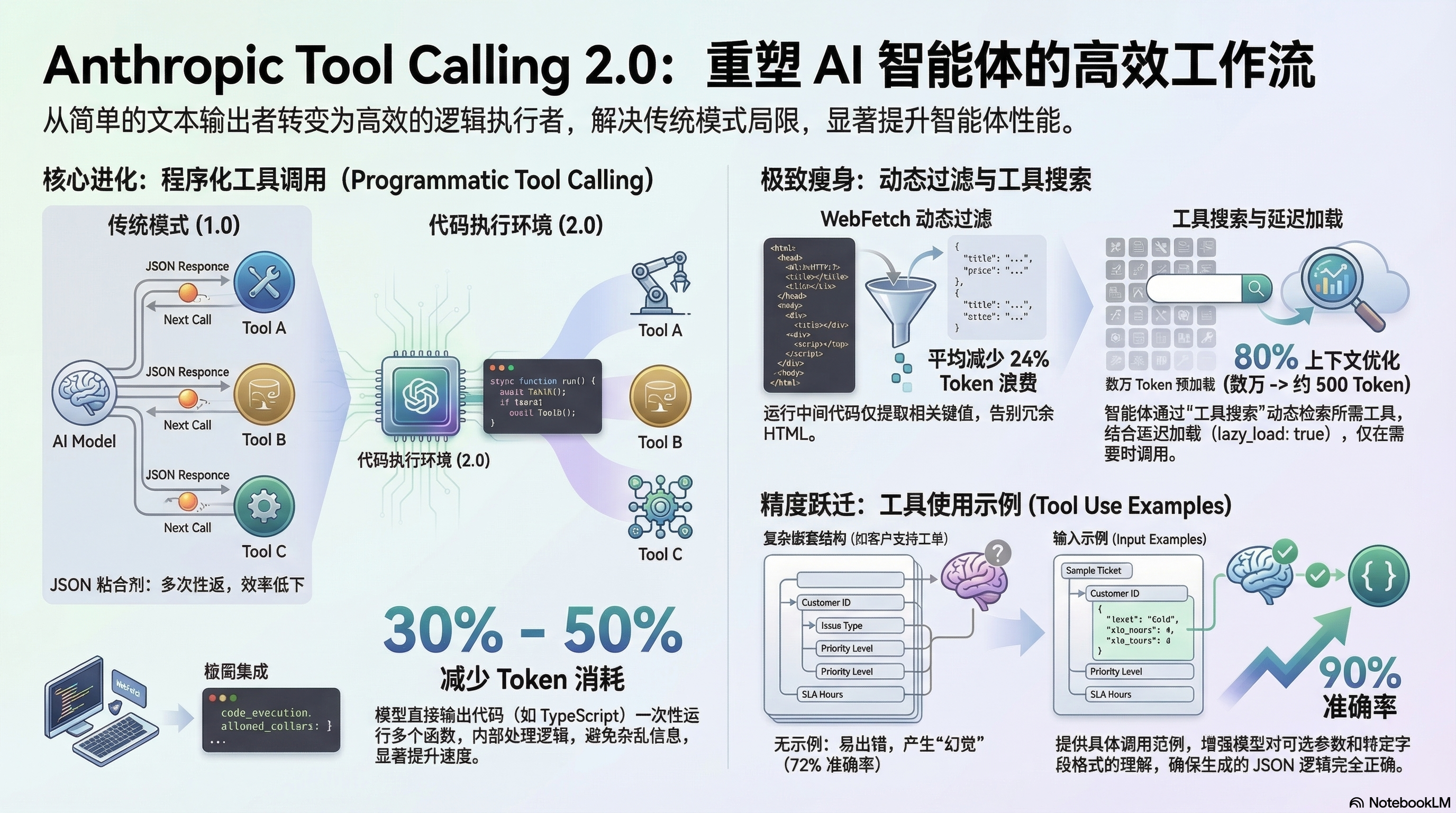
1. The Paradigm Shift: From JSON-Based Interaction to Programmatic Tool Calling

As Chief AI Solutions Architects, we are witnessing a fundamental transition in agentic design: the move from “Tool Calling 1.0”—characterized by static JSON outputs—to “Tool Calling 2.0,” a programmatic execution framework. For technical decision-makers, this evolution is the difference between a brittle prototype and a production-grade autonomous system. The traditional reliance on the model to act as a “glue” layer, manually translating intent into JSON schemas, is being superseded by environments where the model generates executable code to orchestrate its own toolchain.

The limitations of traditional tool calling are rooted in High-Latency Latency Cycles (Ping-Pong Interaction). In this legacy model, an agent must output a parameter, wait for a server response, ingest that response into its context, and repeat. This cycle is not only slow but computationally wasteful, often forcing the LLM to manually re-generate identical identifiers—such as database keys or email IDs—across multiple turns. Programmatic Tool Calling addresses these inefficiencies by treating the LLM as a developer rather than a data entry clerk.

“Asking an LLM to perform tasks solely through JSON-based tool calling is like asking William Shakespeare to write a play in Chinese after only a month of language classes. It might be possible, but it is far from his best or most natural work. LLMs are fundamentally more effective at writing code than they are at generating and reasoning through complex JSON schemas.”

By transitioning to an architecture where the model writes code (e.g., TypeScript or Python) to handle loops, conditional logic, and data passing between tools, we achieve a more deterministic execution flow. This architectural efficiency begins with minimizing the data footprint required for complex reasoning.

2. Mitigating Context Window Waste via Structural Optimization

In the current landscape, there is a significant delta between the “Theoretical Context Window” (often marketed at 1M+ tokens) and the “Effective Context Window,” which realistically sits between 128k and 200k tokens for complex reasoning tasks. To maintain performance, optimizing input content is a strategic necessity for cost management and attention preservation.

The Impact of Programmatic Tool Calling on Token Consumption

Programmatic execution allows for the localization of “messy” intermediate data. In a traditional workflow, the raw metadata of twenty emails might be pumped into the context window just to extract three IDs. With Tool Calling 2.0, this data remains inside the function environment. The code handles the iteration and filtering, returning only the final, relevant signal to the LLM. This architectural shift significantly improves the noise-to-signal ratio in the model’s attention mechanism, leading to a documented 30% to 50% reduction in token usage.

Dynamic Filtering (WebFetch) as a Specialized Efficiency Layer

A prime example of this optimization is Dynamic Filtering within tools like WebFetch (specifically version webfetch_20260209). Instead of dumping raw, noisy HTML into the context window, this layer executes an intermediate code step to filter for pertinent content before the data reaches the LLM.

Key Metric: Dynamic Filtering via WebFetch achieves a 24% reduction in token consumption by stripping non-essential HTML metadata before context ingestion.

Tool Search (MCP) for Scalability

As agentic tool libraries scale into the hundreds, loading every schema simultaneously becomes a bottleneck. The Model Context Protocol (MCP) “Tool Search” mechanism introduces a lazy-loading architecture.

Strategy Context Window Impact Optimization Percentage
Standard Loading High (Full schema library) 0% (Baseline)
Tool Search + Lazy Loading Minimal (~500 tokens for Search tool) ~80% Improvement

These efficiencies ensure the agent remains responsive and cost-effective, directly contributing to higher agentic accuracy by focusing the model’s “attention” on actionable data.

3. Enhancing Agentic Robustness through Precise Parameter Execution

In production workflows, “valid JSON” is a low bar; the true challenge is “correct usage.” Hallucinated parameters or malformed nested structures often break agents in complex support or technical scenarios.

Input Examples for Complex Tool Definitions

The “Input Examples” feature provides the model with a reference array of correct tool calls within the definition itself. This is critical for navigating nested structures—such as linking specific SLA hours to escalation tiers—where the relationship between optional parameters is not always intuitive.

Quantifying Accuracy Gains

The implementation of structured input examples yields a drastic improvement in execution reliability:

Pre-Optimization: 72% Accuracy vs. Post-Optimization: 90% Accuracy

This 18-percentage-point gain is the margin between an experimental tool and a reliable enterprise service.

MCP vs. CLI-Based Approaches

While some developers have migrated to Command-Line Interface (CLI) based tools to save tokens, the MCP approach is architecturally superior due to “Type Safety.” Because the LLM remains aware of the exact input schema and expected patterns, it maintains a level of execution precision that CLI-based methods, which lack structured schema awareness, cannot replicate.

4. Strategic Summary: Quantified Value for Production Environments

The adoption of Tool Calling 2.0 provides a clear path to reducing the Total Cost of Ownership (TCO) while enhancing the reliability of AI agents. By moving away from high-latency “ping-pong” interactions, organizations can deploy faster, leaner, and more capable agents.

Quantified Takeaways:

  • Operational Speed: Dramatic reduction in round-trips via code-based loops and local conditional logic.
  • Cost Efficiency: 30–50% overall token reduction through programmatic data localization.
  • Scalability: 80% context optimization for large tool libraries via Tool Search and Lazy Loading.
  • Reliability: 18-percentage-point increase in parameter accuracy via the Input Examples feature.

Implementation Directive

To capitalize on these gains, technical leadership must update agent runtimes to support the code_execution_20260120 tool. Crucially, developers must implement the allowed_callers parameter; this architectural logic explicitly designates the code execution tool as a valid caller of other tools, enabling the programmatic loop. Furthermore, all web-scraping dependencies should be migrated to webfetch_20260209 to enable dynamic filtering.

The future of autonomous agent architecture lies in the shift from text-based orchestration to a sophisticated, programmatic execution model that prioritizes context efficiency and execution precision.

📎 附件资料

🖥️ 幻灯片预览(支持全屏)


1. The Context Window Bottleneck: Reimagining Memory for Long-Horizon Reasoning

The current landscape of Large Language Models (LLMs) is defined by a persistent architectural constraint: the finite context window. While state-of-the-art models demonstrate remarkable proficiency in short-term information processing, their capacity for long-horizon reasoning—tasks necessitating the maintenance of state over extended temporal scales or complex sub-steps—remains fundamentally tethered to the volume of data that can be actively held in “working memory.” Overcoming these constraints is a strategic imperative for the development of autonomous agents; without sophisticated memory management, agents suffer from rapid performance degradation as critical task context is evicted or diluted.

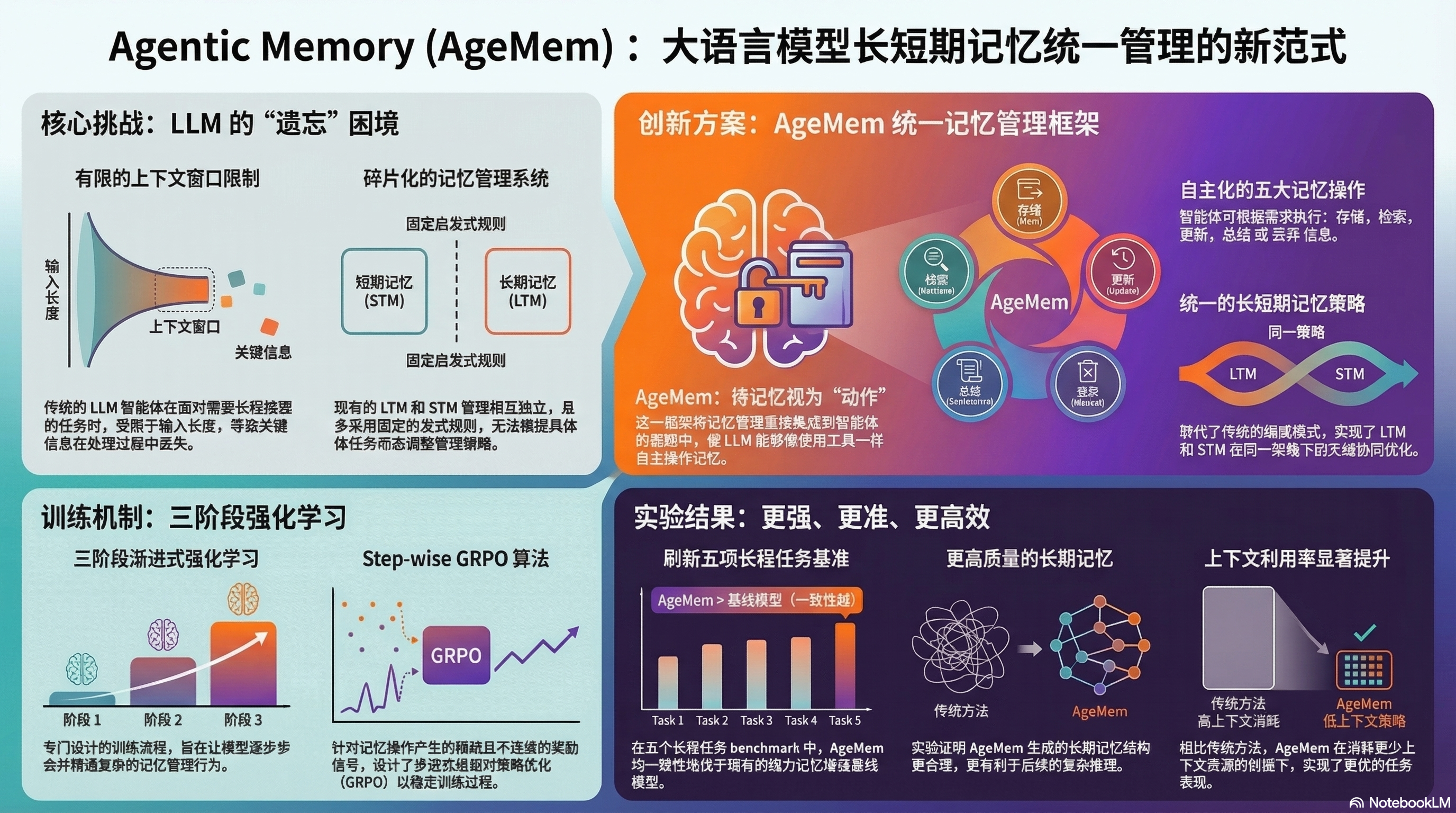
The research presented by Yu et al. (2026) in “Agentic Memory: Learning Unified Long-Term and Short-Term Memory Management for Large Language Model Agents” addresses a core deficiency in existing systems: the reliance on passive heuristics or external auxiliary controllers. These modular approaches often fail to mitigate state-space fragmentation because they are decoupled from the agent’s primary reasoning policy. Such systems cannot be optimized end-to-end, leading to a “semantic disconnect” where the retrieval mechanism is unaware of the agent’s immediate reasoning requirements. The Agentic Memory (AgeMem) framework resolves this by treating memory management as a first-class citizen within the agent’s decision-making architecture.

2. Architectural Paradigm Shift: From Heuristics to Unified Agentic Policy

AgeMem marks a transition from modular, rule-based memory augmentation to a unified, policy-driven architecture. In this paradigm, Long-Term Memory (LTM) and Short-Term Memory (STM) are not managed by fixed algorithms (like RAG or sliding windows) but are integrated directly into the agent’s action space. This allows the model to harmonize policy gradients across both reasoning and memory-management tokens, ensuring that every internal state transition serves the final objective.

Feature Traditional Memory Augmentation AgeMem Unified Framework Latency/Overhead
Optimization Method Modular/Heuristic-based End-to-end Policy Optimization Higher (Inference-time logic)
Control Logic Fixed rules or auxiliary controllers Autonomous, policy-led decision making Moderate (Action sampling)
Adaptability Rigid; relies on predefined triggers High; model-agnostic and state-dependent Low (Native LLM policy)
Integration LTM and STM are separate silos Unified management within the action space Minimal (Integrated embedding)

The critical “So What?” of this architecture lies in its ability to enable end-to-end optimization. By embedding memory management into the agent’s policy, AgeMem allows the LLM to learn the latent utility of its own knowledge base. This eliminates the friction between “reasoning” and “remembering,” as the model can now weigh the cost of memory operations against the probability of task success. This integration facilitates a level of dynamic context steering that was previously impossible under rigid, heuristic-driven regimes.

By conceptualizing memory as an active toolset, the architecture transforms the agent from a passive consumer of context into an active curator of its own cognitive state.

3. Memory as a Toolset: The Taxonomy of Agentic Operations

The AgeMem framework innovates by exposing memory management as a discrete set of tool-based actions. This expansion of the action space allows the agent to exercise granular control over its internal knowledge state. The taxonomy consists of five core operations:

  • Store: The agent proactively identifies high-utility information within the current active context and commits it to LTM, ensuring that critical data is not lost when the context window shifts.
  • Retrieve: When the current STM is insufficient for the task at hand, the agent triggers a retrieval action to ingest specific, relevant historical data from the LTM back into the active window.
  • Update: To mitigate the risk of stale information, the agent can modify existing LTM entries. This ensures state accuracy over time, allowing the agent to correct previous assumptions as new data emerges.
  • Summarize: This operation manages state density by compressing high-cardinality information into concise representations, preserving the “semantic essence” while optimizing the token economy.
  • Discard: Essential for improving the Signal-to-Noise Ratio (SNR), the agent performs autonomous pruning of irrelevant or redundant data to prevent the cognitive clutter that often degrades long-context performance.

These operations allow the agent to govern its internal knowledge state with high precision. By distinguishing between “Update” (maintaining accuracy) and “Summarize” (managing context density), the agent optimizes its context window for maximum reasoning utility. This autonomous governance ensures that the most pertinent information is always prioritized, effectively extending the functional context window beyond its physical limitations.

Mastering this expanded action space, however, requires a specialized training methodology to overcome the challenges of non-differentiable memory operations.

4. Advanced Training Methodology: Progressive RL and Step-wise GRPO

Training an agent to master discrete memory operations is non-trivial due to the presence of sparse and discontinuous rewards. A “Store” action taken at an early timestep may not yield a discernible reward until much later in the episode, creating a significant credit assignment problem.

To resolve this, Yu et al. (2026) propose a Three-Stage Progressive Reinforcement Learning (RL) Strategy:

  1. Stage 1: Foundational Skill Acquisition: The agent is trained on supervised memory trajectories (behavioral cloning) to learn the basic mechanics and syntax of the five memory tools.
  2. Stage 2: Contextual Integration: The agent practices these operations within simplified reasoning environments, learning to trigger specific tools based on the current state-space.
  3. Stage 3: Unified Policy Refinement: The model undergoes full RL to optimize the interplay between memory operations and final task performance, harmonizing the policy for complex environments.

A pivotal innovation in this stage is Step-wise Group Robust Policy Optimization (GRPO). While standard GRPO (popularized for its efficiency in models like DeepSeek-R1) provides stability without a critic model, the “Step-wise” modification is critical for memory-heavy tasks. It enables intra-episode reward credit assignment, allowing the model to receive granular feedback on memory actions rather than relying solely on a single terminal reward. This prevents policy collapse and ensures that the model learns the delayed utility of specific “Store” or “Retrieve” actions, resulting in a more robust and stable gradient during the optimization process.

The successful implementation of this training regimen leads to a model capable of superior performance across diverse architectural backbones.

5. Empirical Validation: Performance, Quality, and Efficiency Gains

The AgeMem framework was evaluated across five rigorous long-horizon benchmarks. The results demonstrate that giving an agent autonomous control over its memory provides three primary value drivers:

  • Task Performance: AgeMem consistently outperformed strong baselines, including traditional RAG and fixed-rule memory systems. On long-horizon reasoning tasks, the model showed a significant delta in performance metrics like Pass@k, proving that agentic control over context is superior to static retrieval.
  • Memory Quality: Agentic control yields higher-quality long-term retention. By selectively “Storing” and “Updating” information based on task relevance, the LTM maintained a high SNR, avoiding the information dilution typical of automated heuristic storage.
  • Context Efficiency: The framework optimized the limited context window through autonomous pruning and summarization. This improved the token economy, allowing the model to maintain higher ROUGE scores for relevant context while using fewer total tokens.

The empirical data across multiple LLM backbones confirms that AgeMem is model-agnostic, providing a scalable solution for any agentic architecture requiring long-term state maintenance. These findings suggest that the framework’s ability to selectively manage its own knowledge base is a fundamental requirement for the next generation of autonomous AI.

6. Conclusion: The Strategic Implications of Autonomous Memory

The AgeMem framework, as detailed by Yu et al. (2026), redefines the role of memory in AI systems. By shifting from “memory as a static storage” to “memory as an agentic tool,” this research mitigates the fundamental constraints of finite context windows that have long hindered LLM development.

The strategic implication for systems architects is clear: the path to truly autonomous, persistent agents lies in the integration of memory management directly into the core reasoning policy. AgeMem provides the necessary blueprint for this evolution, demonstrating that when an agent is empowered to curate its own knowledge state, it achieves a level of reasoning depth and operational efficiency previously unattainable. This research sets a new standard for agentic architectures, paving the way for AI systems capable of handling the most complex, multi-step workflows in modern computing.

📎 附件资料

🖥️ 幻灯片预览(支持全屏)


1. Introduction: The Evolution of AI-Assisted Formal Proofs

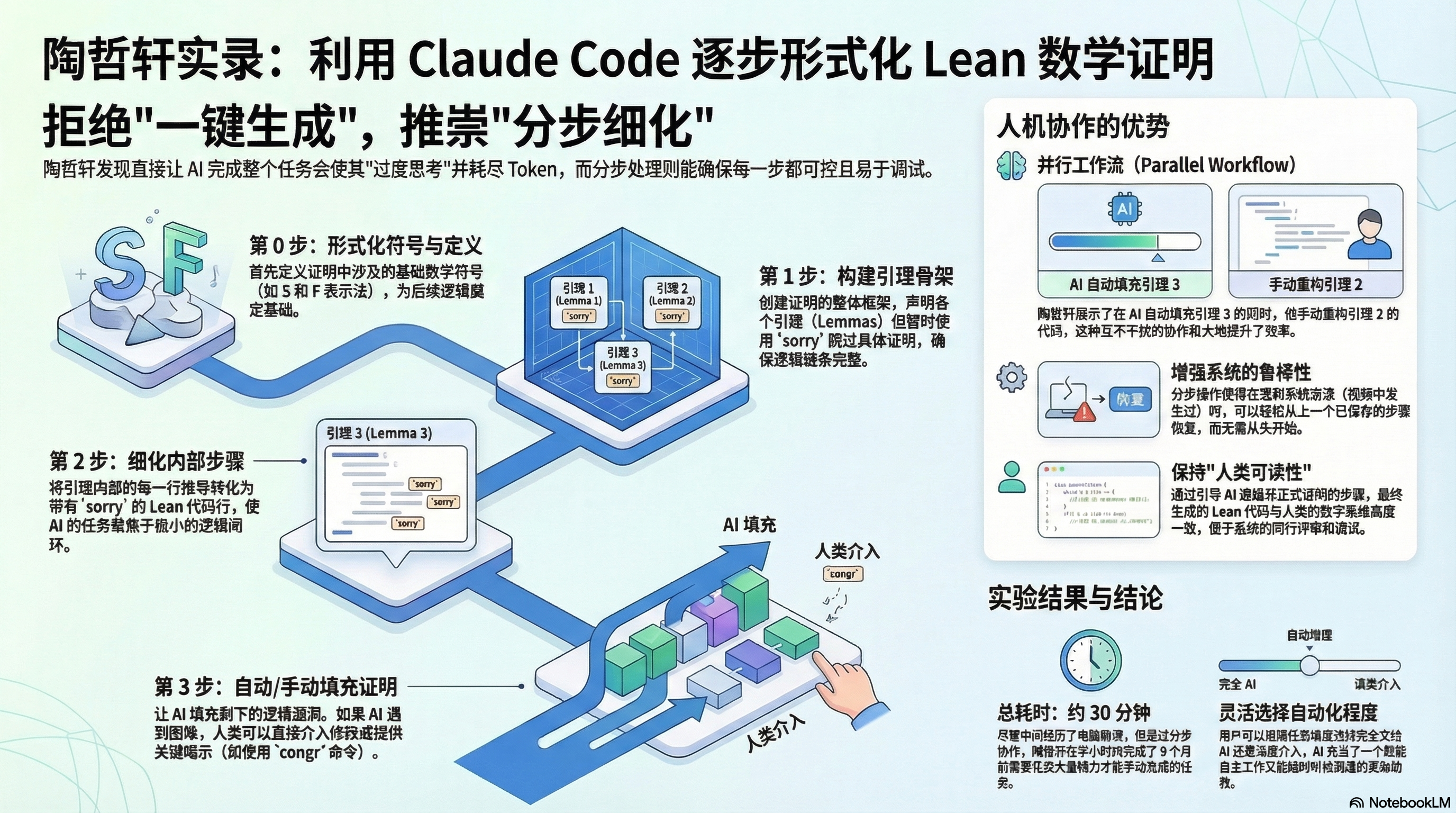
The landscape of formal mathematical verification is shifting from simple “step-by-step manual entry” assisted by autocomplete tools (e.g., GitHub Copilot) to a paradigm of autonomous agent orchestration. In this new model, the mathematician transitions from a coder to a Principal Architect, overseeing high-throughput agents like Claude Code. This shift is necessitated by the inherent brittleness of “monolithic prompting.”

A naive approach—requesting a full formal proof in a single prompt—frequently collapses under the weight of its own complexity. As evidenced in high-level formalization tasks, such attempts often lead to system-level crashes, rapid context window pollution, and “stochastic wandering,” where the agent engages in sub-optimal branching within the proof search. Rather than converging on a solution, the agent “overthinks” the logic, burning tokens on unproductive tactical paths. To achieve professional-grade results, one must move away from unstructured requests toward a rigorous orchestration framework that constrains the agent’s state-space exploration.

2. The “Step-by-Step Recipe”: A Framework for Incremental Success

The primary defense against agent logic drift and task failure is the implementation of a granular “recipe.” By decomposing the high-level formalization goal into distinct, iterative phases, the architect maintains control over the agent’s logical trajectory and prevents the accumulation of “technical debt” in the proof state.

The following four-step framework provides a repeatable structure for formalizing complex informal proofs:

  1. Step 0: Notation & Definitions: Establish the symbolic foundation and notation “shortcuts” (e.g., S and F notations). This ensures the agent operates within a defined symbolic vocabulary, improving readability and reducing token overhead.
  2. Step 1: The Structural Skeleton: Formalize high-level lemma statements (e.g., Equation 1689) without attempting to prove them. Every lemma is closed immediately with the sorry tactic.
  3. Step 2: Line-by-Line Decomposition: Transform the informal proof’s prose into a sequence of Lean code lines. This creates a 1:1 parity between the human argument and the formal structure, with justifications still left as sorry.
  4. Step 3: Systematic Proof Filling: Replace the sorry markers with verified, compilable code, solving each sub-problem individually while monitoring for tactical efficiency.

This modularity ensures resumability. Long-running, unstructured tasks are vulnerable to system crashes and token exhaustion, which often result in total progress loss. However, a Lean file populated with sorry markers remains compilable; this allows the mathematician to restore the logical state immediately after a crash, picking up the formalization from the last verified lemma.

3. Strategic Skeletonization: Preventing LLM “Overthinking”

The “Skeleton-First” strategy is designed to decouple logical architecture (the “What”) from tactical implementation (the “How”). When agents are tasked with proving lemmas immediately, they often become bogged down in the “tactical weeds,” spending excessive context and time on low-level steps that they eventually fail or backtrack upon.

By establishing a “compilable but incomplete” skeleton, the architect fixes the global logical constraints. This prevents the agent from hallucinating divergent logical paths while struggling with local computation.

1
2
3
4
5
6
7
8
-- Example Skeleton State
lemma lemma_one (a b c : Theory) : SBA = a FPC :=
by
sorry

lemma lemma_two (x y z : Theory) : ... :=
by
sorry

This strategy ensures the formal output remains strictly aligned with the informal human proof. It forces the agent to follow the intended argument structure, resulting in a final product that is not only verified but also readable and debuggable for the human supervisor.

4. The Human-Agent Parallel Workflow

The “Parallel Workflow” represents a superior collaboration model where the human and agent operate on different logical tiers simultaneously. Rather than a sequential hand-off, the human performs high-level abstractions or manual tactical fixes while the agent concurrently handles the mechanization of the next phase.

A prime example of this is the extraction of a Key Equation Lemma (or “Slapped Ideal” lemma). While the agent is busy skeletonizing or filling routine “sorries” for a secondary lemma, the human architect may identify a repeating logical pattern and manually extract it into a standalone lemma. This simplifies the proof state and prevents the agent from struggling with redundant logic.

Level of Automation Decision Matrix

Task Type Assigned To Reasoning
Skeletonization Agent High-throughput structural task; establishes global state.
Routine Proof Filling Agent Mechanization of established logical steps.
Error Correction Human Required when agent enters a backtracking loop (stochastic wandering).
High-level Abstraction Human Identifying and extracting standalone lemmas (e.g., Slapped Ideal) to simplify the overall architecture.

5. Overcoming Technical Bottlenecks: Tokens, Logic, and Crashes

Current LLM agents are high-throughput but low-judgment engines. Navigating their limitations requires “constrained autonomy”—intervening at specific failure modes observed during long-range tasks.

  • Context Window Pollution: Unstructured tasks quickly deplete the context window with failed proof attempts.
    • Counter-Strategy: Use the step-by-step recipe to clear the context and focus the agent on a single, isolated sorry at a time.
  • Logic Drift & Over-expansion: Agents may expand terms too aggressively. A common error involves expanding a term like S_A twice when the proof requires only a single expansion to allow for cancellation.
    • Counter-Strategy: Manually intervene using the congr tactic or provide a “one-liner” hint to force the agent back onto a simplified, readable path.
  • Backtracking Fatigue: Agents burn significant tokens by repeatedly failing and retrying the same incorrect tactical branch.
    • Counter-Strategy: When an agent begins to loop, the human must provide a manual tactical intervention or extract a new lemma to reduce the complexity of the current goal.

6. Conclusion: The Future of Formalization via Agent Orchestration

The transition from “AI as a tool” to “AI as an agent” fundamentally redefines the mathematician’s role. Success is no longer measured simply by a finished proof, but by the mathematician’s ability to act as an architect who ensures the formalization is aligned with human reasoning and structured for long-term maintenance. Maintaining this alignment prevents the architect from “turning their brain off,” ensuring they retain the ability to debug and refactor the code as the project evolves.

Best Practices Checklist

  • [ ] Define Step 0: Establish all notation and symbolic shortcuts (e.g., S and F) before the first lemma.
  • [ ] Skeletonize First: Use sorry to map the global proof architecture before committing to local proofs.
  • [ ] Decouple Tiers: Tackle complex abstractions manually while delegating routine mechanization to the agent.
  • [ ] Monitor Expansion: Intervene immediately if the agent produces unreadable, “over-expanded” code blocks.
  • [ ] Ensure 1:1 Parity: Maintain strict alignment between informal proof lines and Lean code blocks to facilitate human-in-the-loop debugging.
0%