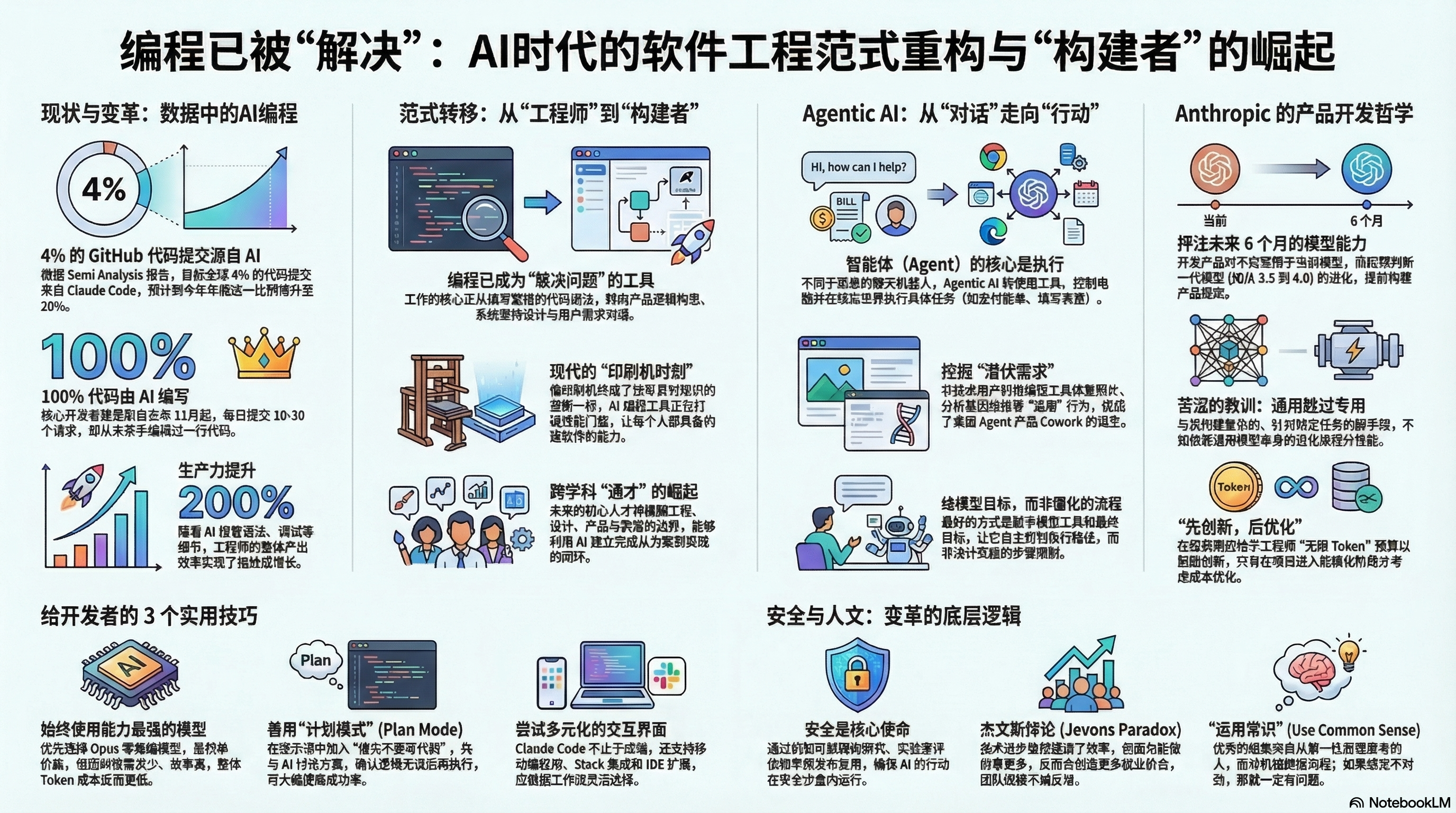
Strategic Report The Builder Era — Redefining Software Engineering in the Age of Generative AI
📎 附件资料
- 在线预览(幻灯片模式):点击打开
- 下载:/assets/the_rise_of_builders.pdf
🖥️ 幻灯片预览(支持全屏)
1. Executive Premise: The End of Coding as a Barrier
The global software landscape is undergoing a structural shift that transcends traditional tooling upgrades. We are moving past the era where programming syntax acts as a gatekeeper to innovation. This transition is historically analogous to the mid-14th-century invention of the printing press. Before Gutenberg, Europe suffered from a sub-1% literacy rate, where the storage and reproduction of knowledge were the exclusive monopoly of a specialized class of scribes. The printing press did not merely lower the cost of books; it dismantled that monopoly, catalyzed the Renaissance, and democratized the power of creation.
Today, Generative AI is our modern printing press, breaking the “monopoly of coding.” The “Specialized Scribe”—the engineer defined solely by their mastery of a specific programming language—is becoming obsolete. In their place emerges the “Builder,” a polymath creator for whom technical execution is a solved problem. For executive leadership, adopting the “Builder” mindset is no longer a strategic choice but a survival necessity in a world where human intent is the primary constraint on production.
-——————————————————————————-
2. Quantifying the Productivity Leap: The 200% Logic
In this new paradigm, traditional metrics like “lines of code” fail to capture enterprise value. Strategic leaders must shift their focus to the Velocity of Intent—the speed at which a conceptual business requirement is transformed into production-ready software. Data from the Claude Code ecosystem confirms this acceleration: currently, 4% of all GitHub commits are AI-generated, a figure projected to surge to 20% by the end of this year.
This shift reached a technological tipping point with the release of the Opus 4 and Sonnet 4 models, which catalyzed the move toward a Zero Manual Edits workflow. Leading practitioners, such as Boris Cherny, report that 100% of their code is now AI-written. By operating at the level of intent rather than syntax, elite builders are managing 10 to 30 code change requests per day, representing a realized productivity gain of approximately 200%.
Traditional vs. AI-Augmented Engineering Output
| Feature | Traditional Engineering | AI-Augmented “Builder” Mode |
|---|---|---|
| Primary Activity | Manual syntax management & debugging | System architecture & intent definition |
| Code Authorship | 100% Human-written | 100% AI-generated (Human-reviewed) |
| Daily Output | Manual syntax debugging | 10–30 Intent-based requests |
| Skill Focus | Language-specific expertise | Product logic & cross-functional design |
| Bottleneck | Coding speed & syntax errors | Clarity of vision & system design |
-——————————————————————————-
3. From Chatbots to Agents: The Rise of “Agentic AI” and Cowork
The next frontier of AI is defined by Action, not just conversation. We are transitioning from Software as a Tool to AI as an Employee. This is the rise of Agentic AI, exemplified by tools like Cowork, which can launch browsers, manipulate terminal environments, and execute complex real-world tasks like paying parking tickets or filing healthcare PDF forms.
The development of these agents is driven by the discovery of Latent Demand—the “misuse” of technical tools by non-technical users to solve esoteric problems. High-impact signals of this demand include:
- Scientific Analysis: Processing MRI images and Genomic Data Sequencing.
- Agricultural Optimization: Using coding agents to manage Tomato planting schedules.
- Data Forensics: Recovering lost wedding photos from corrupted hard drives.
These use cases demonstrate that Agentic AI is bridging the gap between technical silos and general business operations, allowing the system to act as a cross-functional autonomous collaborator.
-——————————————————————————-
4. The “Builder” Archetype: Cross-Disciplinary Polymaths as the New Moat
As technical specialization is “flattened” by automation, the new competitive moat is cross-disciplinary breadth. The archetype of the modern leader is Boris Cherny himself: a non-CS major (Economics) who initially taught himself to program not for the love of syntax, but to “cheat” on math tests by building custom solvers. This pragmatic, problem-first approach defines the Builder.
At firms like Anthropic, the traditional boundaries between roles are dissolving. We are seeing a profound blurring of responsibilities:
- Designers are now shipping functional production code.
- Finance and HR personnel are utilizing agentic tools to build their own automated workflows.
- Engineers are shifting their focus to product vision and user experience.
This is a return to the creative essence of problem-solving. The most valuable talent in your organization is no longer the “deep specialist,” but the polymath who applies Common Sense to bridge the gap between human needs and digital solutions.
-——————————————————————————-
5. Strategic Frameworks for the AI-First Enterprise
Enterprise success is increasingly a matter of philosophy and architecture rather than specific LLM selection. To maintain a First Principles mindset, organizations should adopt three pillars:
- The Six-Month Rule: Never build for current model limitations. Assume the capabilities of models six months from now. Early adopters of Claude Code succeeded because they built for a world of 100% code generation even when the models could only handle 20%.
- The “Bitter Lesson” Application: Credited to researcher Rich Sutton, this lesson teaches that hand-coded “scaffolding” and rigid human-designed workflows provide short-term gains but are eventually “flattened” by the exponential growth of universal models. CTOs must prioritize minimal scaffolding and let the model’s internal reasoning find the execution path.
- The Innovation Budget: Adopt an Unlimited Token policy during R&D. The cost of tokens is negligible compared to an engineer’s salary. Restricting experimentation to save on compute costs is a strategic error that stifles the discovery of high-value internal products.
-——————————————————————————-
6. The Safety Mandate: Mechanical Interpretability and Trust
Trust is the ultimate prerequisite for scaling AI. Anthropic’s safety culture, which lured Boris Cherny back to the firm, is built on a technical architecture designed to create long-term enterprise value:
- Layer 1: Mechanical Interpretability: Pioneered by Chris Olah, this involves “peering under the hood” of the neural network to track neuron activation. This allows us to detect if a model is attempting to be deceptive or planning outside its parameters.
- Layer 2: Laboratory Evaluation: Testing models in synthetic scenarios to ensure alignment with human values.
- Layer 3: Early Public Deployment: Using research previews to gather real-world feedback in a controlled manner.
Strategically, the Open-Source Sandbox serves as a vital industry standard. It ensures that agents operate within strict boundaries—preventing unauthorized system access—while facilitating interoperability between different companies’ agents. This prevents a “Wild West” of autonomous actions and ensures a safe, collaborative ecosystem.
-——————————————————————————-
7. Strategic Conclusion: Navigating the Jevons Paradox
The fear of job displacement in the “Builder” era is addressed by the Jevons Paradox: as the “cost” of a resource (coding) decreases through efficiency, the total consumption of that resource increases. We are not facing a decline in the need for engineers; we are witnessing the opening of an Infinite Backlog.
By solving the “coding problem,” we are finally enabling human talent to tackle the 90% of global problems—from climate tech to localized logistics—that were previously “economically unfeasible” to code. For leaders, the mandate is clear: move beyond managing “coders” and begin empowering Builders. In a world of automated syntax, Common Sense and creative vision are the ultimate competitive advantages. The AI revolution is not about replacing humans; it is about the radical maximization of human creativity.