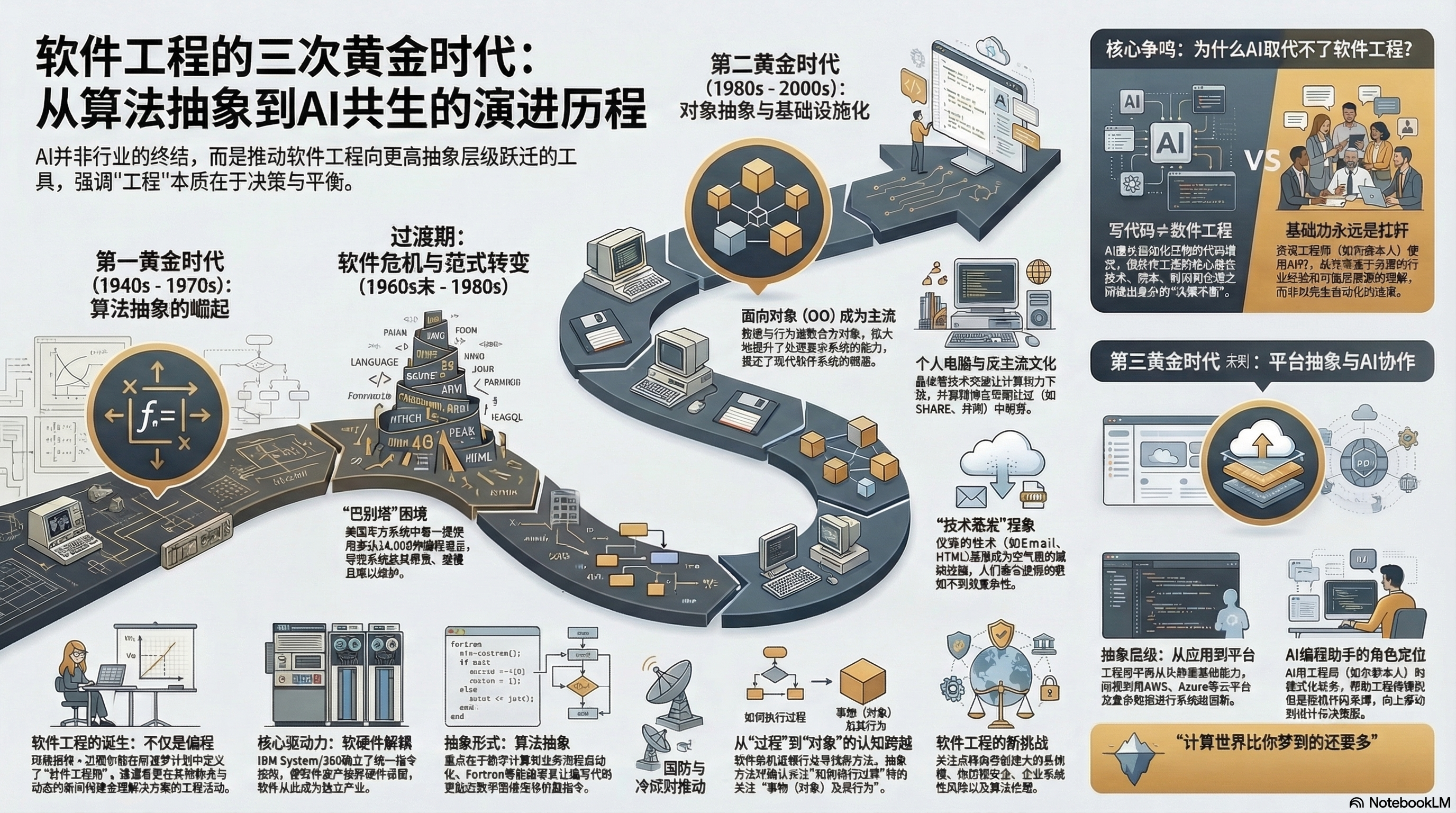
The Third Golden Age Architecture, Abstraction, and the Human Core of Software Engineering
📎 附件资料
- 在线预览(幻灯片模式):点击打开
- 下载:/assets/software_s_third_golden_age.pdf
🖥️ 幻灯片预览(支持全屏)
1. Defining the Domain: Software Engineering vs. Scripting
The contemporary technological landscape is currently defined by a climate of existential volatility. When Dario Amodei, CEO of Anthropic, predicts that software engineering will be fully automated within twelve months, he isn’t merely making a technical forecast; he is triggering a strategic crisis of identity. For the Chief Technology Officer, navigating this shift requires more than just procurement of AI tools—it requires a precise, historical understanding of what engineering actually is. To confuse the act of writing code with the discipline of engineering is a fundamental category error that leads to catastrophic architectural neglect.
Software engineering, a term coined by Margaret Hamilton during the Apollo program to distinguish her work from the prevailing hardware-centric culture of NASA, was never about the perfection of syntax. It was defined then, and remains today, as the pursuit of a reasonable solution within a web of dynamic and static constraints. As codified by the strategist Grady Booch, the discipline is held aloft by four interweaving forces:
- Science: The foundational mathematical and algorithmic invariants.
- Technology: The transient tools, hardware, and languages of the era.
- Human: The sociology of teams and the orchestration of collective intelligence.
- Ethics: The legal, social, and moral weight of the systems we manifest.
The “12-month automation” fallacy rests on the belief that software engineering is synonymous with implementation. It is not. AI can generate code patterns, but it cannot yet navigate the “reasonable” path between competing pressures of cost, time, and human impact. Engineering is the art of decision-making under constraint, a reality that has persisted from the era of punch cards to the age of Large Language Models.
2. The Historical Necessity of Abstraction: Three Golden Ages
History teaches us that “automation panic” is a recurring cycle that invariably results in an upward leap in productivity rather than the obsolescence of the practitioner. Every time a low-level friction is abstracted away—whether by the first compilers or the first frameworks—the architect is freed to operate at a higher level of complexity. We are now entering the third such epoch.
The Three Eras of Software Evolution
| Era Name | Core Abstraction | Primary Driver | Key Technologies |
|---|---|---|---|
| The First Golden Age (1940s–1970s) | Algorithm Abstraction | Hardware Decoupling & Numerical Complexity | Fortran, IBM System/360, SAGE, ALGOL |
| The Second Golden Age (1980s–2000s) | Object Abstraction | System Complexity & “The Babel Problem” | C++, Object Pascal, Smalltalk, Java |
| The Third Golden Age (Present Day) | Platform Abstraction | Ecosystem Orchestration & Systemic Risk | AWS, Salesforce, AI Agents, Cloud Native |
In the First Golden Age, the imperative was to decouple software from hardware. Pioneers like Grace Hopper realized that software must become an industry unto itself. This era was forged on “sorrow’s looms”—the military-industrial complex of the Cold War. Systems like SAGE (Semi-Automatic Ground Environment) were so massive they consumed nearly 30% of all software engineers in the United States. The focus was on processes: mathematical formulas and automated business logic.
By the late 1960s, the “Software Crisis” emerged. The industry faced a “Babel Problem”—the U.S. military alone was grappling with over 14,000 distinct programming languages. This fragmentation made systems expensive, slow, and fragile. The industry responded by shifting to Object Abstraction, moving from a process-oriented view to a Platonic view of the world as a collection of “things.” This shift allowed for the creation of elegant, enduring architectures, such as the Object Pascal structures of MacWrite and MacPaint—designs so robust their DNA persists in modern professional suites.
Today, we have ascended to Platform-level Abstraction. Modern architects no longer build components; they orchestrate “economic castles.” Platforms like AWS or Salesforce represent shared infrastructure where the cost of self-building is prohibitive. The architect’s role has shifted from masonry to urban planning, managing the flows between these massive, pre-existing entities.
3. AI as the Engine of “Disposable Automation”
In the Third Golden Age, AI tools (GitHub Copilot, Claude, Cursor) serve as the modern equivalent of the compiler. They are engines of efficiency designed to abstract away the “friction of implementation.” However, we must be intellectually honest about their boundaries.
The Limits of Pattern Matching AI is currently “islanded” within the well-trodden paths of CRUD (Create, Read, Update, Delete) and common Web patterns. While it excels at these “disposable” tasks, it fails at the “frontier complexity” of computation. The world of software is broader than LLM training data dreams of—encompassing real-time distributed systems, novel scientific computing, and deep-space autonomy.
AI-generated code is largely “use-and-throw.” It lacks the Structure of Elegant Software that survives through superior design. Much like the transition to COBOL or Fortran, natural language is becoming a “quasi-programming language.” The architect’s value has moved upstream: they are no longer the typist, but the Requirement Definer and Outcome Verifier. The professional value is no longer in the how of the code, but the why of the system intent.
4. The Human Core: Decision, Balance, and Systemic Risk
As software becomes the “invisible air” of civilization, the consequences of architectural failure have escalated from technical glitches to societal destabilization. This creates a “Human-Centric Engineering Pillar” that algorithmic logic cannot replace. There are four critical areas where human agency remains the only safeguard:
- Technical Decision-making: Navigating trade-offs where there is no “correct” answer, only a “reasonable” one.
- Cost-Benefit Balancing: Mediating the economic reality of the business against the technical integrity of the system.
- Ethical Judgment: Addressing the “Can vs. Should” dilemma. Just because we can implement autonomous surveillance or biased facial recognition does not mean we should.
- Systemic Risk Management: In an era of platform-level abstraction, the failure of a single entity (like an AWS region) can threaten global social stability.
Architects are now the stewards of civilization’s infrastructure. When a system is “embodied” in society—like the global email protocols or the financial ledgers—the architect must manage the risk of the entire system, not just the application. AI can optimize a routine; it cannot assume the legal or moral liability of a systemic collapse.
5. Future-Proofing the Architect: Resilience Through System Theory
To remain relevant, the modern architect must hedge against tool obsolescence by returning to first principles. The pivot is clear: we must move from an Application Focus to a System Focus.
Cross-Disciplinary Inspiration The blueprints for the next generation of decentralized, resilient architecture will not be found in code repositories, but in the study of complex systems.
- Biological Systems: Studying how organisms maintain homeostasis without central control.
- Neuroscience: Utilizing Minsky’s “Society of Mind” or “Global Workspace” theories to design multi-agent AI architectures.
- Complex System Theory: Drawing from the Santa Fe Institute to understand emergent behaviors in interconnected networks.
This is not theoretical. My experience with NASA’s Mars missions proved that deep-space autonomy—where a robot must survive on a distant planet without a human tether—is a system engineering problem. It requires “embodied” intelligence that mimics biological secondary control architectures (like those proposed by Rodney Brooks).
The Imagination Mandate The Third Golden Age is not a threat; it is the removal of friction. By automating the mundane, AI finally allows the engineer to focus entirely on the Imagination of what is possible. The limits of the profession are no longer the speed of our typing or the syntax of our languages, but the depth of our systemic vision.
As we stand on the threshold of this new era, we face a choice. We can stare into the perceived abyss of automation and fear the fall, or we can recognize that the floor has simply risen beneath us. For those who embrace the shift from coding to systemic design, it is finally time to take the leap of faith.
It is time to fly.