GPT-5.4 Technical Evaluation Report Assessing the Shift Toward Autonomic Digital Employees
📎 附件资料
- 在线预览(幻灯片模式):点击打开
- 下载:/assets/gpt-54_digital_employee_briefing.pdf
🖥️ 幻灯片预览(支持全屏)
1. Executive Summary and Strategic Context
The release of GPT-5.4 (Thinking and Pro versions) marks the definitive transition from conversational AI to the era of “Digital Employees.” Architecturally, GPT-5.4 serves as the orchestration layer for the autonomous enterprise, integrating high-level reasoning, complex logic synthesis, and native computer control into a unified framework. For the strategic leader, this update represents a move away from “chatting with a bot” toward “deploying a workstation-ready agent” capable of executing end-to-end workflows within the existing corporate software stack.
Core Architecture and Capability Overview
| Feature | GPT-5.4 Thinking (Standard) | GPT-5.4 Pro |
|---|---|---|
| Primary Capability | Native Computer Use & Reasoning | High-End Research & Logical Synthesis |
| Context Window | 1,000,000 Tokens | 1,000,000 Tokens |
| Strategic Function | General Knowledge Work Automation | Scientific/Technical Breakthrough Capacity |
| Availability | Plus, Team, Pro, Enterprise | Pro and Enterprise |
These advancements collectively redefine enterprise productivity benchmarks. By transitioning from answering queries to occupying workstations, GPT-5.4 collapses the gap between strategic intent and operational execution.
-——————————————————————————-
2. Native Computer Use (NCU) and Visual Perception Mastery
Native Computer Use (NCU) is the foundational requirement for the autonomous digital workforce. Unlike traditional RPA (Robotic Process Automation) or API-dependent tools, GPT-5.4 interacts with the operating system as a human does: via visual perception and peripheral input. This represents a departure from rigid integrations toward flexible, human-centric automation.
Performance on OSWorld-Verified Benchmark
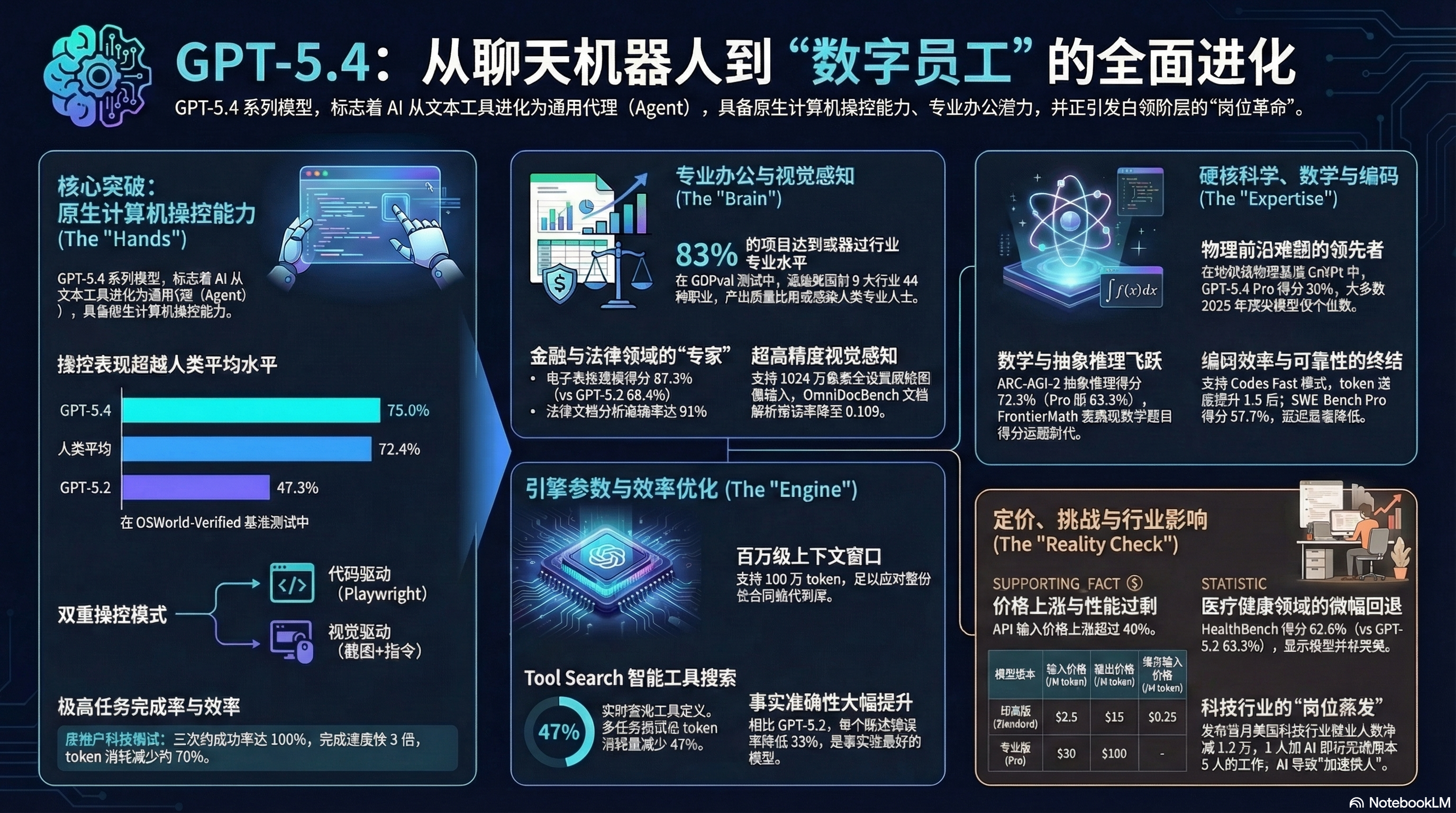
The model’s mastery of the OS environment is evidenced by its 75.0% success rate on the OSWorld-Verified benchmark, significantly outperforming GPT-5.2 (47.3%) and even exceeding human performance (72.4%).
The “So What?” Evaluation:
- Human-Centric UI Automation: Exceeding human-level performance (75%) allows the model to reliably navigate legacy software and internal tools that lack dedicated APIs, rendering traditional integration barriers obsolete.
- Obsolescence of API-limited Workflows: The agent can operate directly on the desktop, managing files and cross-application tasks via coordinates and screenshots, moving the bottleneck from “software compatibility” to “instruction clarity.”
- High-Reliability Execution: The leap from 47.3% to 75.0% indicates that agentic workflows have moved from experimental “proofs of concept” to production-ready deployments.
Efficiency and Fidelity: The Mainstay Case Study
Analysis of data from Mainstay CEO Dodd Fraser confirms these gains in the real estate sector. In a test across 30,000 property tax portals, GPT-5.4 achieved a 95% first-try success rate and 100% within three attempts, compared to just 73-79% for previous models. These results were accompanied by a 3x increase in execution speed and a 70% reduction in token consumption.
To achieve this, GPT-5.4 utilizes the “Original Image Input Precision Mode,” supporting up to 10.24MP (6,000 pixels on the longest side). This high-fidelity perception is the model’s competitive advantage, allowing it to parse complex UI hierarchies and documents with a 0.109 error rate (OmniDocBench). Coupled with a 92.8% success rate in Online-MindToWeb (screenshot-only interaction) and 67.3% in WebArena-Verified, the model establishes itself as a viable, browser-based automation agent capable of complex document parsing and data entry without human intervention.
-——————————————————————————-
3. Vertical Industry Performance and “GDPval” Benchmarking
The economic utility of GPT-5.4 is quantified via the GDPval benchmark, which evaluates performance across 44 occupations in the top nine U.S. industries. This benchmark measures whether AI output reaches “Professional Parity” with human industry practitioners.
Industry Performance Matrix
| Metric | GPT-5.4 | GPT-5.2 |
|---|---|---|
| GDPval Overall Success | 83.0% | 70.9% |
| Investment Banking (Excel Modeling) | 87.3% | 68.4% |
| Legal Document Accuracy (Harvey BigLaw) | 91.0% | N/A |
| Professional Clear Win Rate | 69.2% | N/A |
The Professional Parity Layer
The 69.2% clear win rate over industry professionals suggests that GPT-5.4 is no longer just assisting; it is outperforming. In the legal sector, the Harvey BigLaw Bench results (91% accuracy) highlight the model’s ability to maintain consistency across long-form contracts and analyze structured complex transactions with granular detail. In financial services, the automation of scenario analysis led to a 30-percentage-point increase in accuracy. This data indicates that the “white-collar revolution” is underway, as the model demonstrates the ability to handle the primary drafting, modeling, and analytical tasks of senior-level roles.
-——————————————————————————-
4. Advanced Coding, Engineering, and Scientific Reasoning
The evolution of the Codex engine has transformed coding from a pattern-matching task into a deep logical synthesis. The introduction of “Thinking” and “Fast” modes (offering a 1.5x token speed increase) significantly reduces developer friction and latency.
Benchmarks in Engineering and Science
- SWE-Bench Pro: 57.7% (surpassing the 56.8% of GPT-5.3-Codex).
- APEX-Agents: 50%+ (the first model to cross this threshold, up from <5% just one year ago).
- FrontierMath: 38.0% (Pro version) on Tier 4 competition-level problems.
- CritPt (Physics): 30.0% for Pro (xhigh).
The “So What?” of Scientific Reasoning: The CritPt benchmark consists of 71 unpublished, “hell-level” problems. Scoring 30.0% on data the model could not have encountered in training is definitive proof of reasoning over pattern matching. This capability allows the model to act as a genuine research collaborator, capable of high-level synthesis such as reverse-engineering Nintendo NES ROMs or building custom compilers from scratch—tasks where competitors often stall.
Infrastructure for Reasoning
Sustaining this level of intelligence requires a robust hardware and contextual backbone. The 1M-token infrastructure and the ability to toggle between “Thinking” and “Fast” modes allow the system to manage entire codebases or massive scientific datasets simultaneously, providing the necessary compute-depth to resolve problems that previously required human-level intuition.
-——————————————————————————-
5. Large-Scale Context Reliability and Tool Ecosystem Optimization
While 1M-token context windows offer vast potential, the MRCR v2 benchmark reveals a significant “Unreliability Zone” at the upper limits. Architects must design systems that respect these retrieval decay boundaries.
Context Retrieval Performance (MRCR v2)
| Context Zone | Token Range | Retrieval Accuracy | Strategic Classification |
|---|---|---|---|
| Practical Utility Zone | 0 - 128K | 86% - 97% | Reliable Production Use |
| Marginal Utility Zone | 128K - 256K | 79.3% | Requires Verification |
| High-Risk Zone | 256K - 512K | 57.5% | Experimental Only |
| Unreliability Zone | 512K - 1M | 36.6% | Non-Viable for Precision |
Tool Ecosystem Efficiency
To solve “context bloating,” GPT-5.4 introduces Tool Search via the MCP Atlas benchmark. By utilizing a “lightweight list” approach—querying full tool definitions only when required—the model achieved a 47% reduction in token consumption. This allows for the integration of dozens of tools (e.g., 36 MCP servers) without sacrificing speed or accuracy. Additionally, the Thinking version’s real-time reasoning previews allow for user-directed course correction, further optimizing the consumption of compute resources.
-——————————————————————————-
6. Economic Analysis: Pricing, ROI, and Performance Regression
Deploying GPT-5.4 requires a nuanced “cost of intelligence” strategy. The Pro version offers unprecedented depth but at a premium that necessitates a strict Enterprise Routing Strategy.
API Pricing Structure
| Model Version | Input (per 1M) | Output (per 1M) |
|---|---|---|
| GPT-5.4 Thinking | $2.50 | $15.00 |
| GPT-5.4 Pro | $30.00 | $180.00 |
Cost-to-Value Critical Analysis
The Pro model’s propensity for “over-thinking” can lead to significant economic inefficiencies. The “Hello” problem—where a Pro model cost a CTO $80 for a five-minute reasoning chain on a simple greeting—highlights the need for dynamic routing. Enterprises should route 90% of tasks to the Thinking/Standard model, reserving Pro for specialized research, physics, or high-stakes coding.
Furthermore, minor regressions in HealthBench (62.6%) and Terminal-Bench 2.0 (75.1%) should be viewed as multi-modal optimization trade-offs. The architecture is being tuned for general-purpose computer use and reasoning, occasionally at the expense of hyper-specialized terminal command or medical consensus performance.
-——————————————————————————-
7. Governance, Safety, and the “White-Collar Revolution”
GPT-5.4’s autonomic capabilities are balanced by high-level safety ratings and a paradoxical impact on the labor market.
Safety and Security
- Preparedness: Rated “High” for Cybersecurity and Biochemistry.
- Integrity: Deception rates remain low at ~1%.
- COT Controllability: The model demonstrates lower control over its internal reasoning chains; while this may seem like a drawback, it serves as a security feature that prevents external prompts from masking malicious logic or overriding internal safety protocols.
The Structural Unemployment Trend
The deployment of GPT-5.4 is actively restructuring the workforce. Data shows a net loss of 57,000 tech jobs over the last year (12,000 in the last month alone). This is not a symptom of corporate failure, but of AI efficiency:
- Obviating Roles: Organizations are moving from 5-person teams to “1 Human + 1 AI.”
- Cannibalizing General Talent: While general software and administrative roles are being displaced, vacancies for AI-specific developers are surging.
GPT-5.4 has moved from answering questions to occupying workstations. It is no longer an assistant; it is a digital employee that is quietly, but aggressively, infiltrating the global workforce.