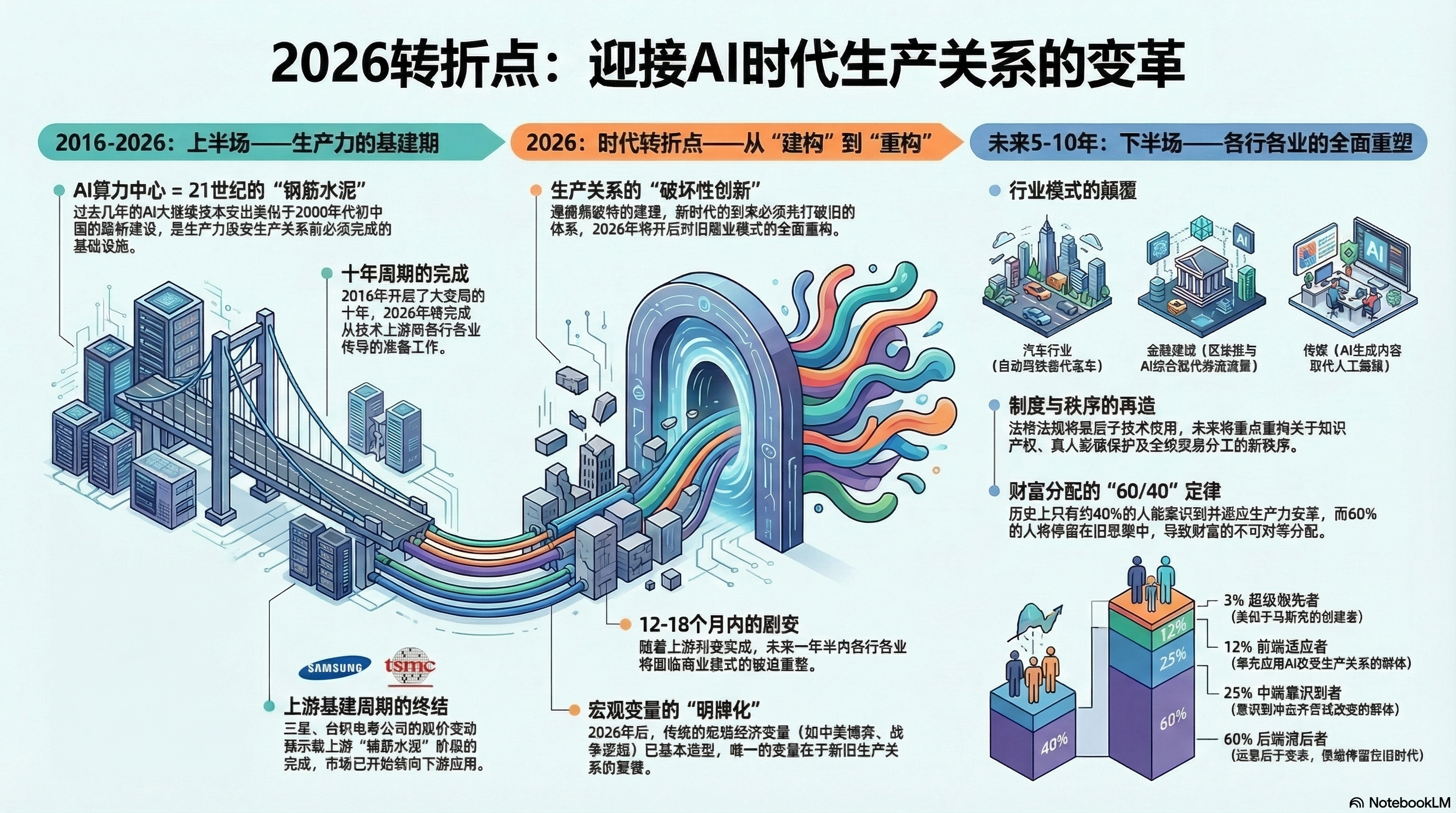
The 2026 Tipping Point AI-Driven Reconstruction of Global Production Relations
📎 附件资料
- 在线预览(幻灯片模式):点击打开
- 下载:/assets/2026_ai_paradigm_shift.pdf
🖥️ 幻灯片预览(支持全屏)
1. The Macro Perspective: 2026 as the Definitive Strategic Inflection Point
The decade spanning from 2016 to 2026 will be recorded as a “century-level” structural pivot. We are currently navigating the final transition of a ten-year cycle, shifting from an era of “Construction” (asset accumulation) to a period of “Competition” (model dominance). In the logic of macro-evolution, 2026 represents the critical handover point. If the first half of this cycle was defined by the accumulation of technological potential, the second half is defined by the violent restructuring of global production relations.
This transition is driven by the synchronization of the Three-Gear Framework:
- Production Forces (Productivity): The raw technological capacity, now exploding through AI and ubiquitous compute.
- Production Relations: The business models, labor structures, and organizational hierarchies that utilize those forces.
- Institutional Order: The legal, geopolitical, and financial systems that provide the rules of engagement.
When these gears align, the result is “Destructive Reconstruction.” We are witnessing a historical rhyme of the late 1960s to the early 1980s. During that era, the “Nationalism” of the Cold War prioritized strategic physical assets—metals like Silver and Tin (famously cornered by the Hunt brothers) for missile guidance and heavy industry. Today, the focus has shifted from “Nationalism” to a “Market Logic” defined by Total Factor Productivity, where the primary strategic asset is no longer a physical metal, but Intelligence.
Historical Parallel: The Great Transition
| Dimension | Industrial-to-Semiconductor (1960s-80s) | AI-Driven Transition (2016-2026+) |
|---|---|---|
| Geopolitical Tension | Cold War heights; focus on strategic metals (Silver/Tin) for nuclear deterrents. | Tech Sovereignty; focus on Intelligence/Compute as the primary production factor. |
| Technology Adoption | From manual typewriters and paper ledgers to Personal Computers (PC) and DOS/Windows. | From manual search and App-based ecosystems to AI-synthesized intelligence and FSD. |
| Institutional Reform | Thatcherism/Reaganism; dismantling legacy welfare states for market efficiency. | Reconstruction of IP, financial direct-clearing, and algorithmic governance. |
As we exit the “Building Phase” of this cycle, corporate strategy must pivot from asset-building to aggressive model-restructuring. In this high-stakes environment, holding onto legacy success is a form of structural arbitrage against one’s own future.
-——————————————————————————-
2. The “Steel and Cement” of the Digital Age: Completion of Upstream Infrastructure
In recent years, the massive capital expenditure (CapEx) in AI has been dismissed by some as a “debt trap.” This perspective fundamentally misinterprets the nature of industrial transmission logic. We are currently reliving the high-impact debate of the early 2000s between Lin Yifu and Guo Zhong regarding Chinese infrastructure: Is it “wasteful debt” or a “productivity prerequisite”?
Just as China built the roads before the cars in 2002, the current explosion in data centers and computing power is the “steel and cement” of the digital age. This infrastructure is not a burden; it is the foundational requirement for the “Upstream-to-Downstream” transmission cycle.
We are currently at the Peak of the Raw Material Cycle. The recent stock market performance of upstream giants like Samsung Electronics, SK Hynix, and TSMC mirrors the 2002–2005 Chinese stock cycle. Back then, the bidding for roads and bridges led to a peak in steel and cement prices, signaling that the infrastructure was largely complete. Today, when the “raw materials” of AI—semiconductors—reach their peak investment, it signals the immediate beginning of industry-wide destructive reconstruction for the downstream. The “roads” are now paved; the focus must shift entirely to the “vehicles” (business models) that will dominate them.
-——————————————————————————-
3. Creative Destruction: The 12-18 Month Efficiency Revolution
We have entered a 12-to-18-month window of Schumpeterian “Creative Destruction.” In the ledger of history, “death” of the old is the non-negotiable prerequisite for “birth” of the new. Efficiency is no longer an incremental KPI; it is a violent reordering of capacity enhancement and process shortening.
The “Efficiency Revolution” is dismantling legacy structures across three critical fronts:
- Transportation/Automotive: We are transitioning from vehicle ownership to autonomous utility. The integration of Full Self-Driving (FSD) is transforming the car into a functional service. This renders the labor-heavy models of “ride-hailing drivers” and traditional taxi fleets structurally obsolete.
- Media/Information: We are witnessing the “Disappearance of the App.” The paradigm is shifting from searching and clicking to “Direct AI Questioning.” As Sun Yuchen noted, the future isn’t about communicating with humans; it’s about asking AI to interpret human intent. When users ask an AI agent to “synthesize the last 24 hours of news,” the entire intermediary layer of editors and researchers collapses.
- Professional Services: The foundational “hand-work” of coding, basic research, and editorial synthesis is facing an efficiency collapse. Programmer anxiety is not a trend; it is the first wave of a massive compression in the value of human intermediaries.
The Strategic Reality: There is no “harmonious coexistence” with AI while maintaining 20th-century processes. To achieve the 10x gains offered by new production forces, businesses must first dismantle the labor-intensive workflows of the past. If you do not destroy your current model, the market will perform the execution for you.
-——————————————————————————-
4. Institutional Lag and the Reordering of the Global Logic
Technological production forces move at light speed, while institutional frameworks move at the speed of bureaucracy. This friction creates a “chaotic zone” where the rules of the old world are increasingly irrelevant.
We identify three Institutional Reconstruction Zones:
- Intellectual Property & Identity: AI-generated content and deepfakes represent an existential crisis for IP. Legal frameworks must shift to protect personality rights and digital identities as real, tradeable assets, moving away from 20th-century copyright logic.
- Financial Infrastructure: We are moving toward “Wallet-to-Wallet Direct Trading.” The traditional chain of “Bank \rightarrow Broker \rightarrow Exchange” is full of institutional friction. Blockchain-integrated AI will allow direct clearing and settlement, removing the need for 20th-century intermediaries who exist only to facilitate trust.
- Global Trade & Geopolitics: The logic of production factors has shifted from physical territory and raw materials to intelligence and compute. Traditional “territory-grabbing” warfare is becoming strategically obsolete.
Geopolitical Insight: Current global conflicts (Eastern Europe, the Middle East) are not the “start” of a new era of war; they are the “violent end” of the old order. They represent the final gasps of a system based on old production factors. The new global order will be dictated by those who control the efficiency of the AI value chain, rendering physical territory a secondary concern.
-——————————————————————————-
5. Strategic Differentiation: Navigating the 15/85 Cognitive Divide
The reordering of production relations dictates a new, non-linear distribution of wealth. This is not a matter of social fairness, but of cognitive adaptability. Based on historical technology cycles, we face a specific Cognitive Distribution Rule:
- 3% are super-leaders and creators driving the change.
- 15% are early adopters at the front end (the “Survivors”).
- 40% only grasp the impact once mass application is already complete.
- 60% are the “Lagging Group,” whose roles and skills have become structurally obsolete.
To remain in the Top 15%, decision-makers must execute a three-step “Survival & Growth” checklist:
- Embrace “Pre-fabrication”: Abandon the “hand-made” nostalgia of the past. Much like the transition from “artisanal” sushi to high-efficiency pre-made production, the market no longer rewards the “human touch” at the cost of scale. If the future is moving toward pre-fabrication, you must integrate AI workflows or face the “hand-made” price trap.
- Shorten the Value Chain: Aggressively identify where AI can eliminate intermediate costs. Any process that involves mere “information relay” or “manual synthesis” is a structural liability.
- Join the Vanguard: If you cannot beat the efficiency curve, you must join it. Resistance is not a strategy; it is a path to the bottom 60%.
The Final Verdict: The coming 18 months will define the winners and losers of the next decade. Success is no longer found in defending what you have built, but in your willingness to destroy your current success to build future relevance. The era of the “both/and” is over; the era of radical efficiency has begun.