The Coming AI Flood Tian Yuandong on Memory, Moats, and Why the Logic of the World is Shifting
📎 附件资料
- 在线预览(幻灯片模式):点击打开
- 下载:/assets/full_stack_ai_reconstruction.pdf
🖥️ 幻灯片预览(支持全屏)
The pace of artificial intelligence development has reached a velocity that threatens to outstrip human physiological limits. In a candid dialogue with Silicon Valley Vector, Tian Yuandong—former Research Director at Meta and a pioneer in large-scale model optimization—suggests we are standing in the deceptive calm before a cataclysmic surge. While industry observers fixate on the release cycles of new models, they are often blind to a more profound structural transformation: the “logic” of the world is being fundamentally rewritten. The impending displacement we face is not merely a failure of individual competence, but a total obsolescence of the industry’s underlying axioms.
Your Favorite AI Model Has No Secret Sauce
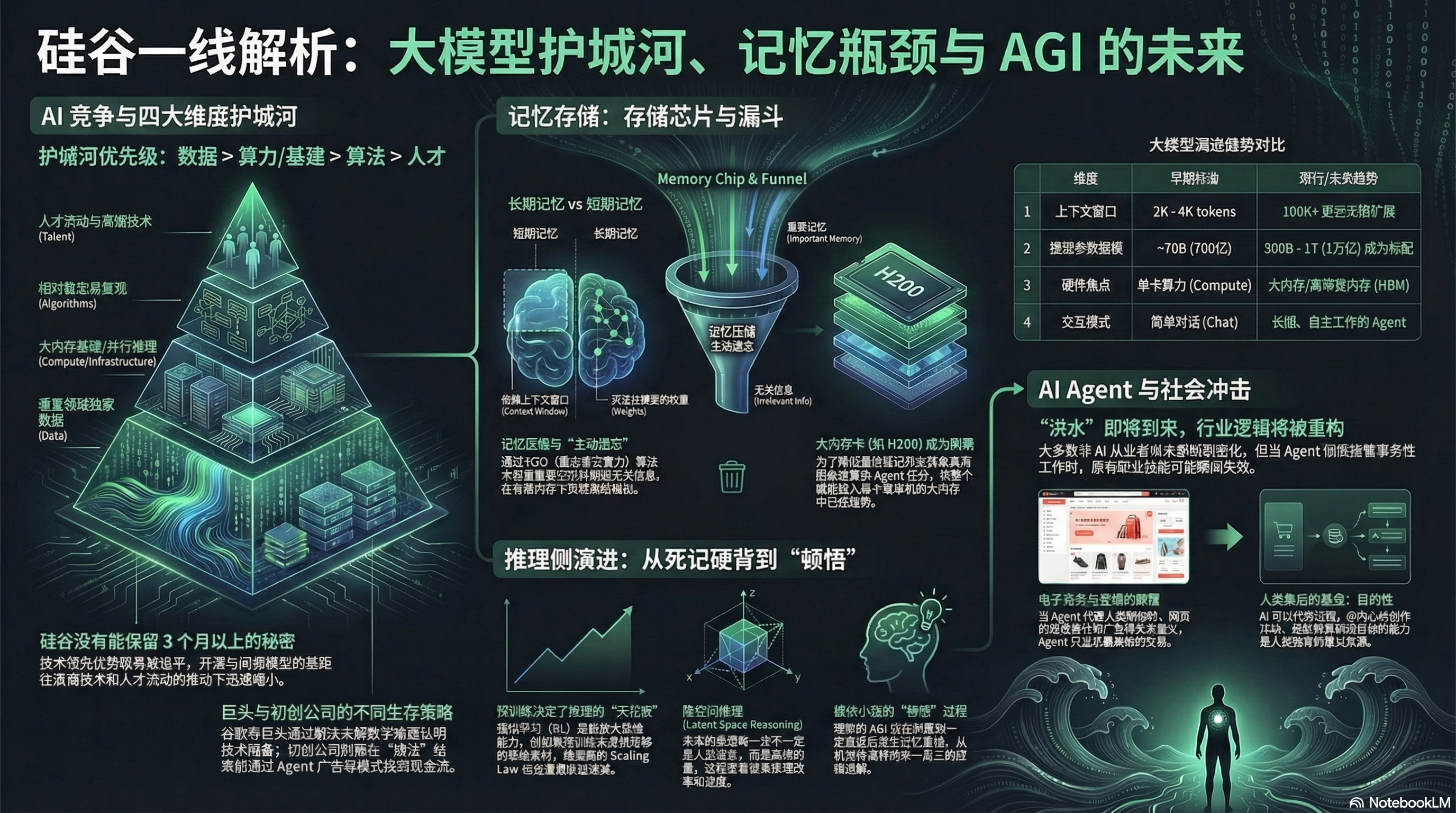
In the elite tiers of AI development, the traditional “moats” of technical algorithms and individual talent have effectively evaporated. Tian describes a phenomenon of “theory flow” within Silicon Valley, where the constant migration of researchers and the rapid dissemination of ideas ensure that any technical advantage has a shelf life of only two to three months.
When forced to rank the pillars of a sustainable moat, Tian prioritizes Data as the primary and most enduring advantage, followed by Infrastructure. Algorithms and talent, once considered the crown jewels of tech, have been relegated to “fluid assets.” This leveling of the playing field is accelerated by distillation—a process where smaller models “harvest” the intelligence of superior models to rapidly close performance gaps. For tech giants like Google or Meta, releasing models is less about protecting a secret and more about a strategic showcase of “talent reserves” and branding to maintain their status in the first tier.
“In Silicon Valley, it’s hard for a secret to be kept for long. Once a new solution is developed, after two or three months, everyone knows a bit about it.”
The “Childhood” of AI Memory—From Rote Learning to Insight
The evolution of Large Language Model (LLM) memory is currently transitioning from a “mechanical” phase to a “logical” one. We are moving beyond the era of simply inflating context windows—a field Tian advanced with his “Position Interpolation” paper—toward sophisticated architectures designed for “active forgetting” and “sublimation.”
Technical milestones like Attention Sink (which maintains continuity by preserving initial tokens) and H2O (Heavy Hitter Oracle) provide the proof of work for this shift. These methods allow a model to maintain a fixed memory capacity while selectively retaining only the most critical information. Tian draws an analogy to his own daughter’s cognitive development: a child initially memorizes numbers through rote repetition, but eventually reaches a moment of “enlightenment” where the internal logic of mathematics is reorganized. At this point, the child moves from “associative memory” (simple mapping) to “grasping the essence” (understanding the big picture). Future AGI will likely mirror this human trait—trading granular, exhaustive data for “sublimated” insight.
“In my vision, the future AGI will have a fixed brain capacity that performs continuous memory sublimation and active forgetting.”
Open Source as “Nuclear Deterrence”
For Tian, the proliferation of open-source AI is not a mere business preference; it is a mechanism for global power equalization. He argues that a world where only a few “closed” labs possess the most powerful models leads to a dystopian class divide.
Open source functions as a form of “nuclear deterrence.” By democratizing high-level calculation and reasoning capabilities, we create a stable balance of power through mutual capability. Within the strategic halls of Meta, the decision to open-source is often a calculated move to demonstrate technical dominance and recruit the world’s top talent. By providing the tools that become the industry standard, they ensure that while the “secrets” flow, the ecosystem remains built on their foundations.
The Death of the Transactional Internet
The rise of AI “Agents”—exemplified by the Xiao Long Xia (Small Lobster) model—threatens to dismantle the trillion-second economy of the transactional internet. Tian distinguishes between “experiential” tasks, which humans enjoy (browsing for inspiration), and “transactional” tasks, which are friction (booking flights, comparing price points).
The efficiency of these agents will soon be supercharged by Latent Space Reasoning (引空间推理). Rather than processing thoughts through slow, human-language tokens, future agents will operate within high-dimensional vectors. This creates a “quantum-like superposition” of multiple thought paths, making inference 10x more efficient. In this world, flashy web design and strategic ad placements are useless; an agent has no human desires and cannot be distracted by a “buy now” button. However, this shift requires a massive leap of faith regarding security, as users must hand over their most sensitive API keys to these digital surrogates.
“It’s like a child holding all your secrets going to the market. They are efficient, but their judgment is still developing. They could easily be deceived into giving away your home address for a piece of candy.”
“Agents will interact with each other to complete work… making phone calls or manual browsing obsolete.”
The “Flood” and the Redefinition of Career Stability
We must stop viewing AI-driven unemployment through the lens of individual failure. The coming “flood” is structural. When AI increases coding efficiency by 10x, the very logic of the labor market shifts. It is not that workers are “bad” at their jobs; it is that the skills they spent decades perfecting have become automated background processes.
In this landscape, the only remaining human territory is Purpose and Internal Impulse (内心的冲动). A machine can generate a painting or a poem with terrifying efficiency, but it cannot possess the motivation to create. The value of human work will shift entirely from the execution of a task to the impulse behind it—the artist’s drive to manifest a vision that the machine, despite its brilliance, cannot value.
“The work’s meaning lies in how humans define that meaning as their own motive. This ‘internal impulse’ is the one thing the machine and the human do not share.”
Conclusion: Beyond the Scaling Law
The industry currently suffers from a “path dependency.” Large labs continue to pour exponential resources—compute, data, and electricity—into the “Scaling Law” because it is a safe, proven trajectory. However, we are approaching a point of diminishing returns where 10x the resources yield only marginal gains. The next leap will not come from more of the same, but from a fundamental shift in how knowledge is represented and stored.
As we automate the friction out of our lives, we face a final, existential question:
When the “transactional” parts of your life are fully automated by agents, what will you do with the “experience” that remains?